Division on an abacus
----------------------
The oldest algorithm used for division involves the abacus, an ancestor of the counting frame. It consists in going back to the very definition of Euclidean division. Thus, dividing 201 by 13 consists in subtracting 13 from 201 as many times as possible. Of course, it would be tedious to proceed this way. So we try subtracting a larger multiple of 13 from the outset, for example 130, until we can no longer do so. The rule is simple in theory but tricky to apply! In the end, the quotient is 15 and the remainder 6, whichever method is used.
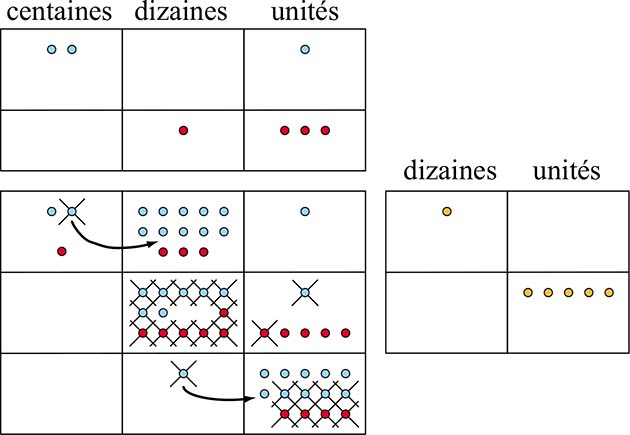
To subtract 13 from 201 as many times as possible, here we chose to start by subtracting 130.
This abacus is the most basic and the most modern, and it is still used today: it is the Japanese counting frame (or soroban).