
Les coniques ne sont pas seulement des objets théoriques : elles se retrouvent aussi dans notre environnement quotidien. Que ce soit en architecture, en ingénierie ou dans les arts, elles sont utilisées pour leurs propriétés esthétiques, acoustiques ou encore mécaniques. Il suffit parfois de lever les yeux lorsque l'on se promène en ville pour en apercevoir…
L'ellipse
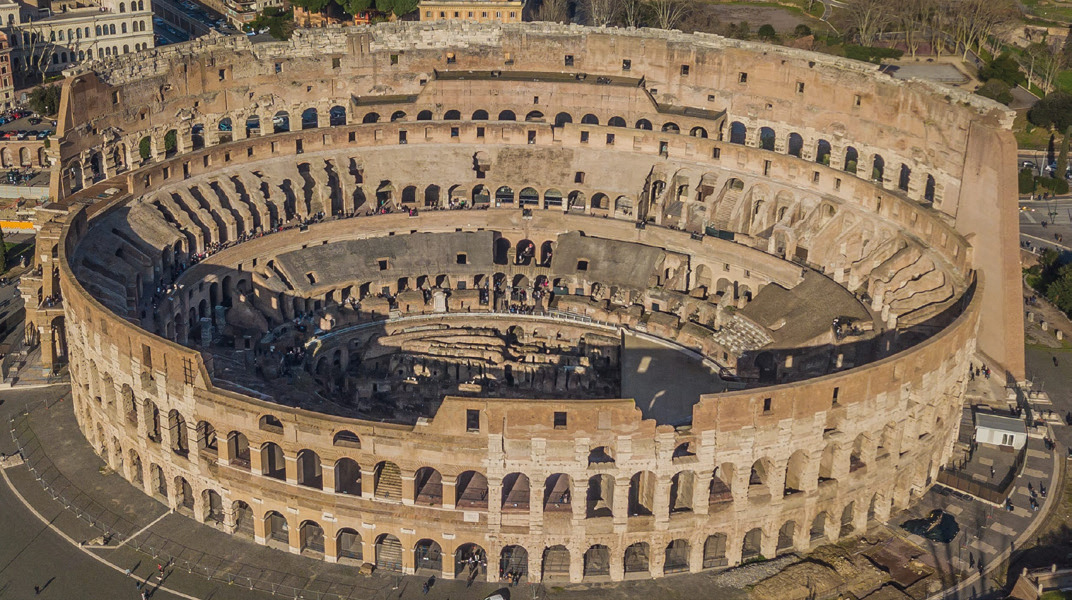
Même si on trouve un plan elliptique pour les Arènes de Nîmes, l'exemple le plus célèbre d'ellipse est celui du monument le plus visité d'Italie, le Colisée de Rome. On présente souvent son plan comme elliptique : c'est une ellipse de grand axe 187 m, de petit axe 155 m. Toutefois, plusieurs chercheurs, parmi lesquels Giuseppe Cozzo, Camillo Trevisan, Paul Rosin et Emanuele Trucco, ont montré que la question n'est pas totalement tranchée. Selon certaines études, la courbe réelle serait plutôt un ovale polycentrique construit à partir de plusieurs arcs de cercle. Les différences avec une ellipse sont si faibles qu'elles sont difficiles à mettre en évidence avec certitude.
À surface comparable, une ellipse possède un périmètre plus important qu'un cercle, ce qui permet d'augmenter la longueur des gradins et donc le nombre de spectateurs pouvant assister aux spectacles avec une bonne visibilité.