Inside Galois's mind as a student
-------------------------------------
In early 1827, Galois discovered mathematics in Mr Vernier's preparatory mathematics class. He already stood out for his approach to the subject: "Elementary algebra textbooks never satisfied Galois, because he could find no trace of their inventors in them."
His biographer, Paul Dupuy, also tells us which books Galois devoured in addition to his textbooks: Legendre's Éléments de géométrie and several works by Lagrange: Traité de la résolution des équations numérique de tous les degrés, Théorie des fonctions analytiques and Leçon sur le calcul des fonctions. All these works are freely available through Gallica, the Bibliothèque nationale de France's search engine.
Later, in his advanced mathematics class, Galois was not content simply to swallow the syllabus whole: "He knew how to rise above the official curriculum: always abreast of advances in science and a regular attendee of Mr Chasles's lectures at the Faculté, he asked questions that tended to broaden the mind rather than narrowing it."
*
*
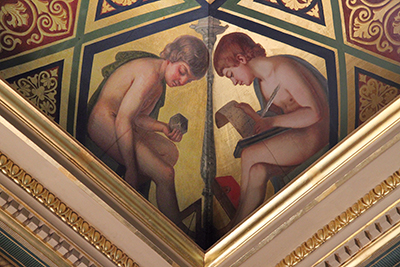
Génies des sciences. Victor Schnetz, 1833.
A scathing critique
-------------------
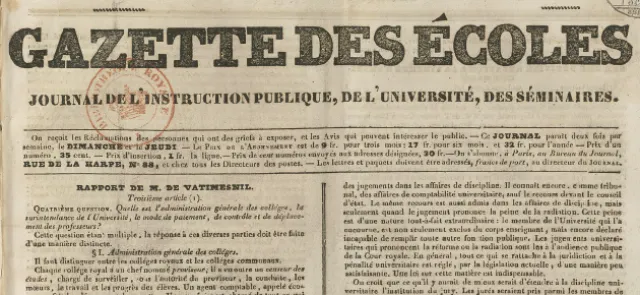
When his criticisms of how mathematics was taught in secondary schools were published, Galois had just been expelled from the École normale after openly clashing with its director, Joseph-Daniel Guigniaut (1794–1876).
"How much longer will these poor young people be forced to spend all day listening or repeating? When will they be given time to reflect on this mass of knowledge, to bring order to this jumble of disconnected propositions and unrelated calculations? Might there not be some advantage in requiring students to use the same methods, the same calculations and the same forms of reasoning, if these were both the simplest and the most fruitful? But no: truncated theories, laden with pointless remarks, are taught in minute detail, while the simplest and most brilliant propositions in algebra are omitted; instead, laborious calculations and invariably lengthy, sometimes false arguments are used to prove corollaries whose proofs are self-evident."
Sur l’enseignement des sciences (excerpt), Gazette des écoles, January 2, 1831.
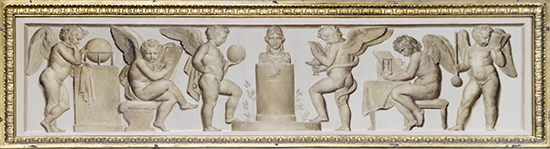
Génies des sciences. Alexandre-Évariste Fragonard, 1832.
The harmful role of examiners
-----------------------------
In a blistering preface written in Sainte-Pélagie Prison, Évariste Galois denounced nepotism and the harmful role of examiners.
"I cannot say that I owe anyone everything good in this work to their advice or encouragement. I cannot say so because it would be a lie. If I had anything to address to the great men of the world or the great men of science (and, nowadays, the distinction between these two classes of people is imperceptible), I swear it would not be thanks."
"The first memoir has not escaped the master's eye; an extract sent to the Académie des Sciences in 1831 was submitted to Mr Poisson for inspection, and he announced at a meeting that he had not understood it. To our eyes, dazzled as they are by an author's vanity, this simply proves that Mr Poisson was unwilling or unable to understand; but to the public, it certainly proves that my book is meaningless. Above all, I shall have to endure the wild laughter of the examiners of candidates for the École Polytechnique (and I am surprised, in passing, not to see each of them occupying a seat at the Académie des Sciences, for their place is certainly not in posterity). Since they tend to monopolize the printing of mathematics books, they will be affronted to learn that a young man twice rejected by them also presumes to write—not textbooks, admittedly, but theoretical works."