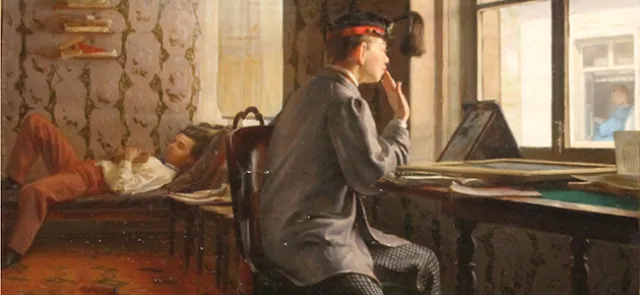
The École normale was founded by the National Convention in 1794 to train teachers. It summoned "from every part of the Republic, citizens already versed in the useful sciences, to learn the art of teaching under the most accomplished professors in every field". In 1808, Napoleon re-established the school under the auspices of the University. In 1822, however, Louis XVIII closed it for being deemed too liberal. A new ordinance then established the École préparatoire in 1826, on the premises of the collège Louis-Le-Grand. It resumed the name École normale (and later regained a measure of prestige) during the reign of Louis-Philippe, following the July Revolution of 1830. The entrance examination for the École préparatoire, which Galois successfully took in 1829, was therefore held from 1826 to 1830.
Galois's mathematics papers, analysed by Caroline Ehrhardt (Évariste Galois, un candidat à l’école préparatoire en 1829, Revue d’histoire des mathématiques 14, 2008), bear no annotations or overall assessment. It is clear, however, that the candidates were not pressed for time: given six hours to answer two questions, they were able to submit papers written in a careful hand. Évariste Galois, who placed second among the six successful candidates, came first on the mathematics paper. Would you have done as well?
The first question
------------------
The second question (see the article "Copies, copies and more copies...") is no longer covered in today's high-school curriculum. The first question, by contrast, can be understood using the tools of calculus now available to students in their final year of high school, even though it does not relate directly to that curriculum.
At the end of the paper, a nota bene specifies that "both preceding questions are equally compulsory" and that "candidates must be denied the aid of any mathematics book". The importance of this last remark becomes clear when one reads the questions! The aim was not to assess the candidates' ability to solve a problem. Instead, candidates were expected to recall standard material: first answer a standard question in the general case, then work through a numerical example for a particular case.