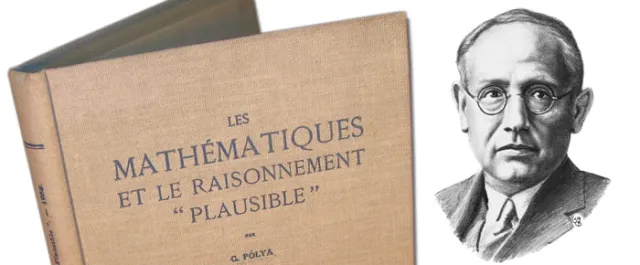
One defining human trait is the ability to reason—that is, essentially, to draw a conclusion convincingly from a set of assumptions. According to George Pólya, reasoning can broadly be divided into two types, depending on the nature of the conclusion:
• plausible reasoning, which yields an uncertain but plausible conclusion ("more or less probable");
• demonstrative reasoning, which yields a certain conclusion (within a clearly defined framework).
In their finished form, mathematics relies solely on demonstrative reasoning, which explains why it is often held up as the benchmark for rigor and truth. But while mathematics is being constructed and developed, it resembles any other form of human knowledge at the same stage: a mathematical statement must be "guessed" before it can, if possible, be proved, and therefore begins life as a conjecture rather than a theorem—at least not yet.
Thus, when working on a new theory, a mathematician proceeds like any other scientist: inductively, seeking a general statement through the careful examination of a few special cases. But induction produces a conclusion that is not certain, only plausible. In the 18th century, the British philosopher David Hume was one of the first to argue that induction is not always reliable. He believed that this kind of reasoning rests on psychological considerations—essentially, a sense of habit—rather than on logical arguments.