
Preda Mihailescu, the "man who toppled Catalan"
-------------------------------------------
The name of the Romanian mathematician Preda Mihailescu appeared in the columns of scientific magazines in 2002, linked to that of the 19th-century Belgian mathematician Eugène Catalan. In fact, Mihailescu had just proved a conjecture more than one hundred and fifty years old. It was in 1844 that Eugène Catalan published the following conjecture in the Journal de Crelle (or Journal für die reine und angewandte Mathematik): *"The following theorem, which I believe to be true, although I have not yet managed to prove it completely: two consecutive integers, other than 8 and 9, cannot both be exact powers; in other words, the equation xm – yn = 1, in which the unknowns are positive integers, admits only one solution (9 – 8 = 1)."*
Mihailescu would publish the proof of it in the same Journal de Crelle a hundred and fifty-eight years later. His proof, long and technical, made use of computer calculations and built on earlier work by Ko Chao (1964), Robert Tijdeman (1976), Yann Bugeaud and Guillaume Hanrot (1998), and Maurice Mignotte (2001).
By contrast, the case of the equation xm – yn = 2 is far from settled. It is conjectured that the only solution to this equation is 33 – 52 = 2. But this equation, which looks similar to the one proposed by Catalan, is in fact very different and far more formidable (it does not allow the use of cyclotomy, which consists in adding roots of unity to a field structure).
-
André Weil's "modesty"
----------------------------
In the early 1980s, the stern and sarcastic André Weil had granted Philippe Boulanger an interview at his home. The reporter accordingly presented himself on rue Auguste-Comte (a philosopher whom Weil detested, because the street's plaque read: "philosopher and mathematician"; Weil disputed that he deserved either title). Perched on the piano stool, the journalist asked his questions, facing the mathematician, who sat comfortably in his large armchair. One question concerned prizes. The father of the famous Weil conjectures, then recently proved, launched into a long diatribe, claiming that prizes were an encouragement to superficial minds and did not reward substantial work, and were therefore a disgrace to their recipients.
The remarks were faithfully reported, and the article was sent to Weil for verification. Wanting to settle certain points, he summoned the author back, again to rue Auguste-Comte. Arriving early, the author bought a newspaper in which he read that Weil had received, and accepted, the richly endowed Wolf Prize! At the appointed time, our contributor entered the sitting room and mischievously reread to Weil the paragraph of his article about prizes, to find out whether he agreed with its content. Weil stated curtly that, unlike journalists, he did not change his mind every day… As he stood at the door on his way out, the author mentioned that he had not congratulated him on the Wolf Prize. Understanding the irony, Weil ordered him to sit back down on his stool and explained at length that only simple minds could see a paradox in this, when it was merely a reflection of his modesty. "If I thought that by refusing this prize, all prizes would be abolished, I would have refused it. But since I believe that my modest person does not have that power, I decided to accept it, as a last resort." Verbatim!
-
The conjecture machine
------------------------
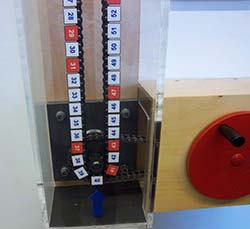
"Every even number is the sum of two prime numbers." Goldbach's conjecture is illustrated by an installation at the Mathematikum in Giessen (Germany) using… a bicycle chain! The integers from 3 to 150 are represented along a circular chain, with the prime numbers, in red, standing out from the rest. The chain is fixed so that the integers facing each other, as at a banquet table, always have the same sum (an even number). The number placed at the end of the chain equals half of that sum. Verification of the famous conjecture (for small numbers) is thus done by identifying, for each position on the chain, at least one pair of red integers.
In the illustration, the number 40 is placed at the end. We can thus see pairs of numbers whose sum is 80. One pair in the image is entirely red (made up of prime numbers): 37 and 43.