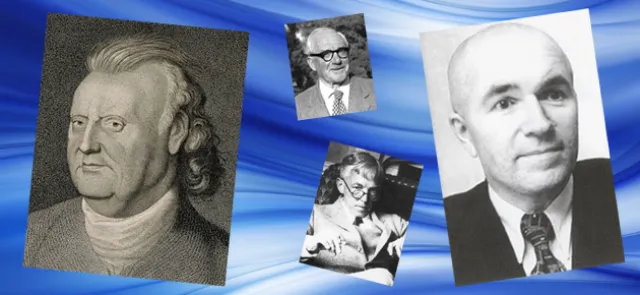
-
*"[…the] following theorem, which I believe to be true, although I have not yet succeeded in proving it completely: two consecutive integers other than 8 and 9 cannot both be perfect powers; in other words, the equation xm – yn = 1, in which the unknowns are positive integers, has only one solution."*
A famous number-theory problem was born!
Progress toward proving this conjecture was slow and initially concerned special cases. As early as 1850, French mathematician Victor-Amédée Le Besgue (1791–1875) proved that, for every prime number p, the equation *x p – y*2 = 1 has no nontrivial integer solutions.
More than a century then passed before Chinese mathematician Zhao Ke (1910–2002) proved the following theorem: if p is prime, then the trivial solutions 32 – 23 = 1 and (–3)2 – 23 = 1 are the only solutions to x2 – *y p* = 1.