Numerous masterpieces of Italian painting, chiefly from the 15th, 16th and 17th centuries, are displayed among the museum's permanent collections in order to bring works from the Neapolitan museum into a "dialogue" with paintings in the Louvre.
In the Grande Galerie, almost level with the entrance to the Salle des États (where Leonardo da Vinci's Mona Lisa is displayed), visitors come face-to-face with the famous Portrait of Luca Pacioli with a Student, attributed to Jacopo de' Barbari (c. 1445–1516). For the Paris museum, the display provides an opportunity to question the painting's attribution to the Master of the Caduceus, as Jacques de Barbary—the French spelling of the presumed artist's name—is known.
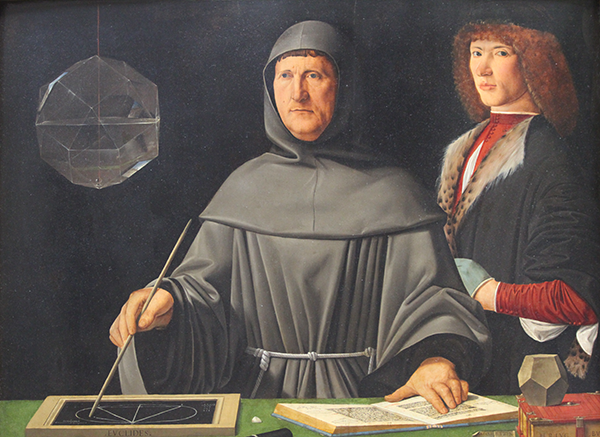
Portrait of Luca Pacioli with a Student, attributed to Jacopo de' Barbari, 1495.
Other mysteries surround the work: who is the student portrayed with the Renaissance mathematician? Could he be the son of the Duke of Urbino, as the exhibition's curators believe, or the German painter and engraver Albrecht Dürer (1471–1528), as some historians argue? Dürer worked on geometric constructions, as did Leonardo da Vinci. The suspended polyhedron also raises questions: did the artist know how to construct it? Why is it half-filled with water?
Do visit the Louvre to admire this masterpiece and try to unravel its mysteries!