The ninth kyu is the beginner level, while the first denotes expert proficiency, before the dan grades. Mastering it makes it possible to perform any arithmetic operation, often faster than with a calculator, and to work with many more digits (at least fifteen). The soroban is therefore used throughout Japan for cashiering in shops, banks and government offices.
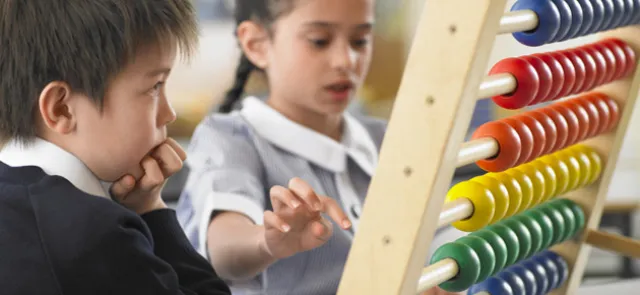
Training begins in early childhood: every year, one million Japanese schoolchildren learn the soroban, which is taught from primary school onward through counting rhymes. It enables students to visualize base-10 calculations easily and manipulate the abacus with two fingers. At the first kyu, a student can multiply a seven-digit number by a four-digit number in under three seconds.
In 2011, the young Rina Horikawa managed to add fifteen numbers of seven to thirteen digits, read aloud by an examiner over the course of one minute, and give the answer… as soon as the final digit was spoken! Likewise, without the abacus, she can add fifteen three- or four-digit numbers in twenty-four seconds, keeping pace exactly as the numbers are read aloud.
In another competition, fifteen integers are flashed in rapid succession on a giant screen. Each number is between 100 and 999. The challenge is to add them together. Takeo Sasano broke the world record in 2015, when all fifteen integers were displayed in just 1.7 seconds!
Working with an abacus helps children develop both mathematical and psychological abilities: memory, spatial awareness, self-control and respect for others.