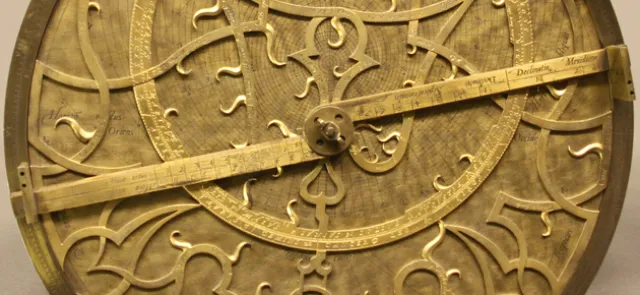
Six questions to solve with an astrolabe
-------------------------------------------
1- At what solar time does the Sun rise on October 16?
2- At what time is the Sun at an altitude of 10° on November 12?
3- At what time does the star Altair rise on the night of April 24–25?
4- At what time is the Sun's azimuth 290° on April 25?
5- On which days is the Sun's altitude 40° at 9 a.m.?
6- What is the azimuth of the star Arcturus at 2 a.m. on the night of April 25–26?
Build your own astrolabe
------------------------
The instrument provided here has very fine graduations, which makes it rather difficult to photograph…
Assembly:
\- Print **the plate** on a sheet of cardstock.
\- Print **the rete and rule** on a sheet of transparent film suitable for use in a printer.
\- Cut around the outlines.
\- Punch a 4 mm hole in the center (the center is marked by a cross on the rete and rule, but on the plate it is the center of the figure—not the zenith—on the north–south azimuth line, "close" to the 50° altitude circle). Remember to use a hole punch!
\- Finally, fasten the different parts together with a split pin.
The instrument provided here was designed for latitude 48°9, that of Juvisy-sur-Orge (Essonne). It gives solar times (meridian transit occurs at noon).
The answers
------------
At what solar time does the Sun rise on October 16?
To answer this type of question, we need to locate the Sun—that is, determine its position on the ecliptic. To do so:
\- Align the line through the center of the rule with the October 16 graduation on the edge of the rete (the black circle in the figure);
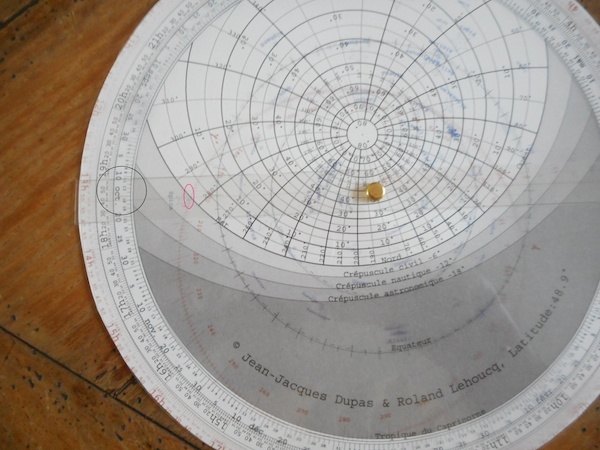
\- The rule's center line intersects the rete's pale-red ecliptic circle (the pink ellipse);
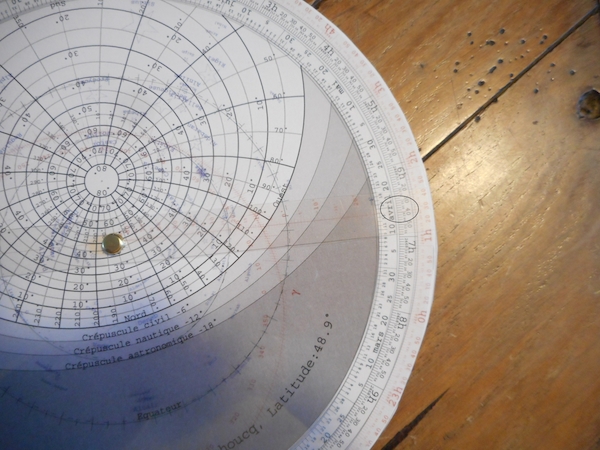
\- Bring this intersection to the 0° altitude circle—in other words, the horizon (for the curious, the Sun's azimuth can also be read off here: approximately 284°…);
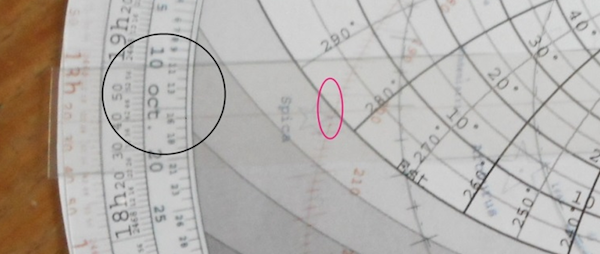
\- On the other side of the rule, the reading is 6:40 a.m. This is the solar time sought.
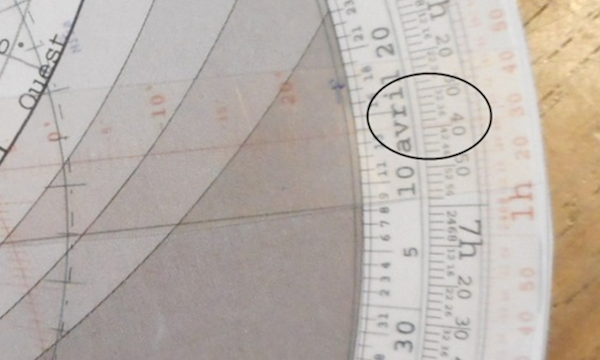
To obtain the local time in Paris, correct this value for the city's longitude—+9 min 21 s for Paris—and for the equation of time (which accounts for the Sun's apparent motion)—−14 min 25 s on October 16. For maximum precision, purists may also allow for atmospheric refraction.
The corresponding local time is therefore 6:34:55 a.m.
At what time is the Sun at an altitude of 10° on November 12?
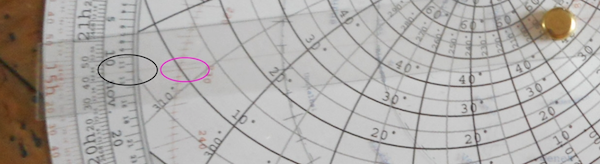
Align the line through the center of the rule with the November 12 graduation on the edge of the rete (the black ellipse in the figure).
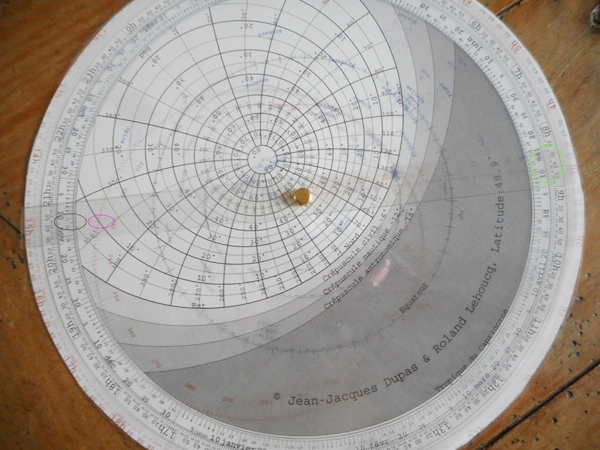
The rule's center line intersects the rete's pale-red ecliptic circle (see the pink ellipse in the photograph). Bring this intersection to the 10° altitude circle on the eastern side for the morning (the curious can also read off the Sun's azimuth, approximately 313°).
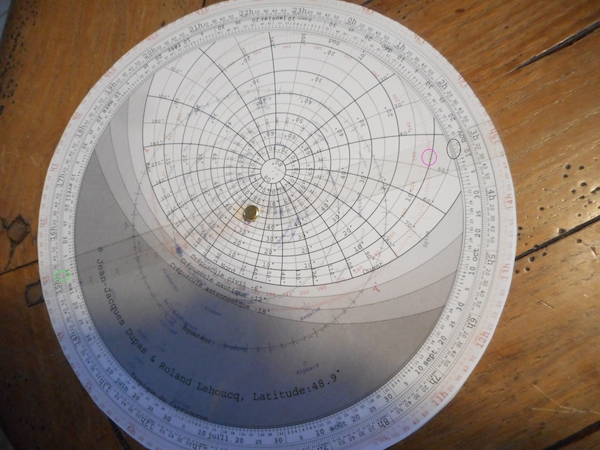
We can then read off the first answer, for the morning: 8:41 a.m.
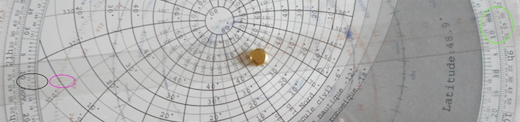
For the evening, continue rotating the rete until it intersects the 10° altitude circle again, this time on the western side (the Sun's azimuth can also be read off and is approximately 46°). The second reading is 3:18 p.m.
At what time does the star Altair rise on the night of April 24–25?
Align the line through the center of the rule with the April 24 graduation on the edge of the rete (the black circle in the figure). The rule's center line intersects the rete's pale-red ecliptic circle, as indicated by the pink circle in the photograph.
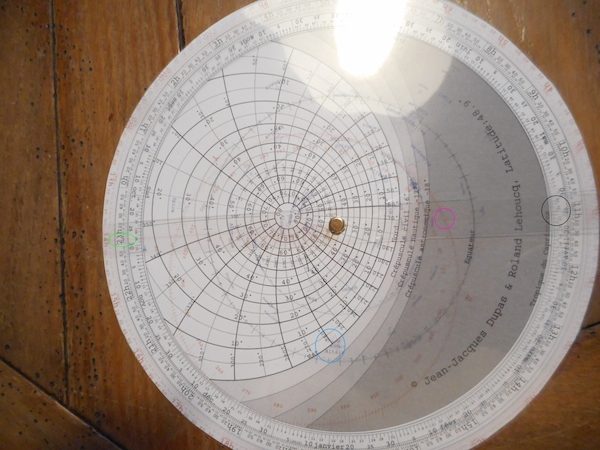
Rotate the rete to bring the center of the star Altair to the horizon on the eastern side (the blue circle in the figure). The time can be read off directly: 11:04 p.m. (the green ellipse on the left of the figure).
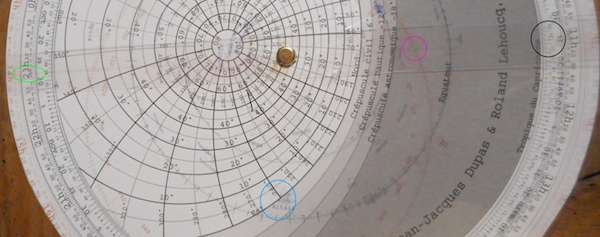
As a bonus, we obtain Altair's azimuth: 258°. We can also check that it is fully dark, since the Sun (the pink circle in the figure) lies below the astronomical-twilight line.
At what time is the Sun's azimuth 290° on April 25?
Align the line through the center of the rule with the "April 25" graduation on the edge of the rete (the black ellipse in the figure). The rule's center line intersects the rete's red ecliptic circle (the pink ellipse in the photograph).
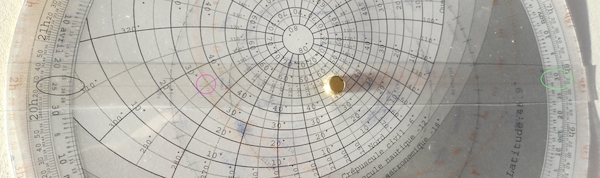
Rotate the rete to bring the Sun's position to the 290° azimuth circle. The time can be read off directly: 8:21 a.m. (the green circle in the figure). As a bonus, the instrument shows that the Sun is at an altitude of 33° in the sky.
On which days is the Sun's altitude 40° at 9 a.m.?
This is the reverse of the previous problem. Set the rule to 9 a.m. (the green ellipse in the figure; here it is actually closer to 9:02 a.m.…). The rule intersects the 40° altitude circle (the pink ellipse). Rotate the rete until you reach April 26.

But if we continue rotating the rete, there is a second solution: August 18!

What is the azimuth of Arcturus at 2 a.m. on the night of April 24–25?
Align the line through the center of the rule with the "April 25" graduation on the edge of the rete (the black ellipse in the figure). The rule's center line intersects the rete's red ecliptic circle (the pink ellipse in the photograph).
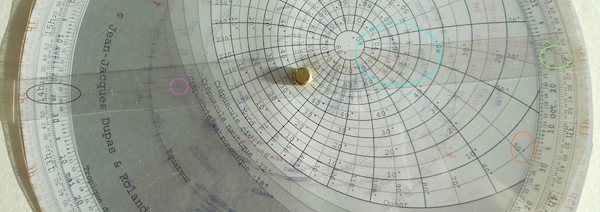
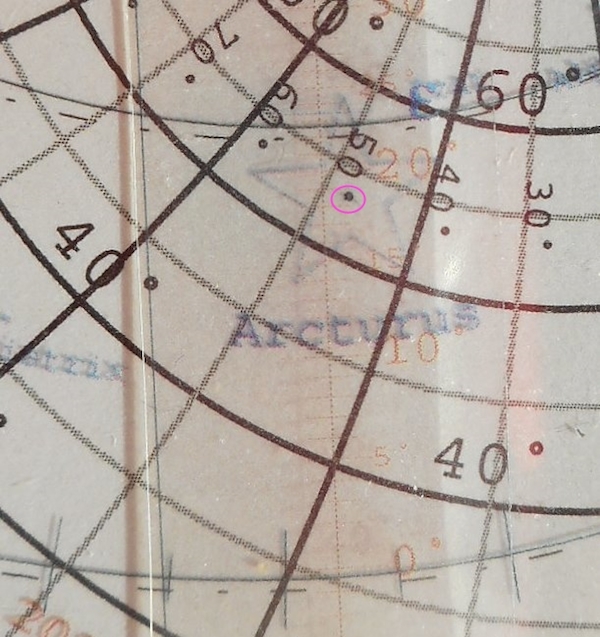
Rotate the rete and rule to align the rule's line with the "2 a.m." graduation (the green ellipse). Locate Arcturus, which lies inside the blue ellipse; its azimuth will be around 50°. The center of the star (the pink ellipse in the second photograph) is at an azimuth of 48° and an altitude of 54°.
By sheer coincidence, the center of the star lies beneath the small circle marking the 50° azimuth graduation.