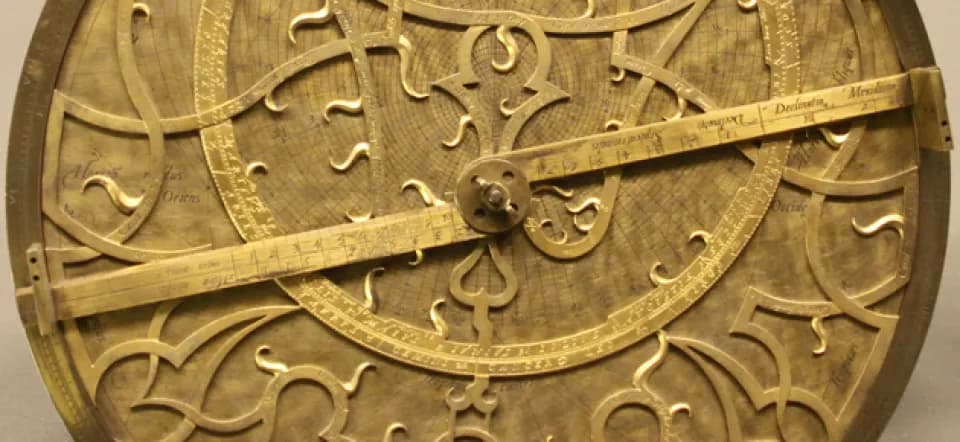
Historical astrolabes can be seen in every science museum. Admire, for example, the magnificent models on display at the Musée des arts et métiers in Paris or in the collections of the Institut du monde arabe! The first surprise, when you see a historical astrolabe, is that you are looking at an entire collection of instruments. The astrolabe was something of a "Swiss Army knife" in ancient times. A typical astrolabe features an alidade, a tympan, a rete, a rule and many other marvels besides…
-
The Swiss Army knife of ancient times
-----------------------------------
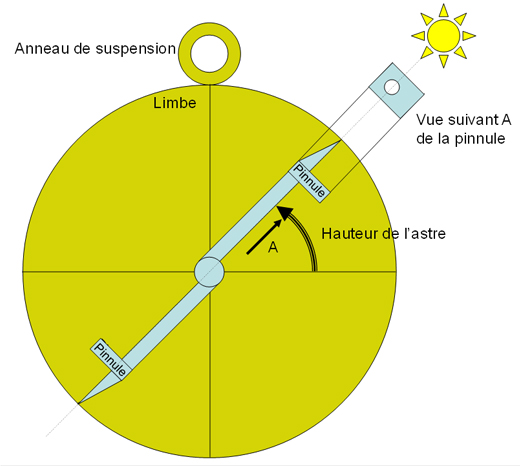
The sighting alidade is a sighting device. It was used to measure the altitude of a celestial body when the astrolabe was suspended. The alidade, from the Arabic al-idada ("forged piece"), is a graduated rule that pivots about the instrument's axis. The sighting vanes are plates fitted with apertures and mounted perpendicularly at either end of the alidade. They were used to sight the object whose altitude in the sky was to be measured. The edge of the astrolabe, known as the limb, was graduated for reading angles. The alidade can therefore measure angles! The very name astrolabe (literally "star-taker" in Greek) probably derives from the use of the alidade. Thus, when an astrolabe is mentioned in a Greek text, it does not necessarily mean the calculating instrument…