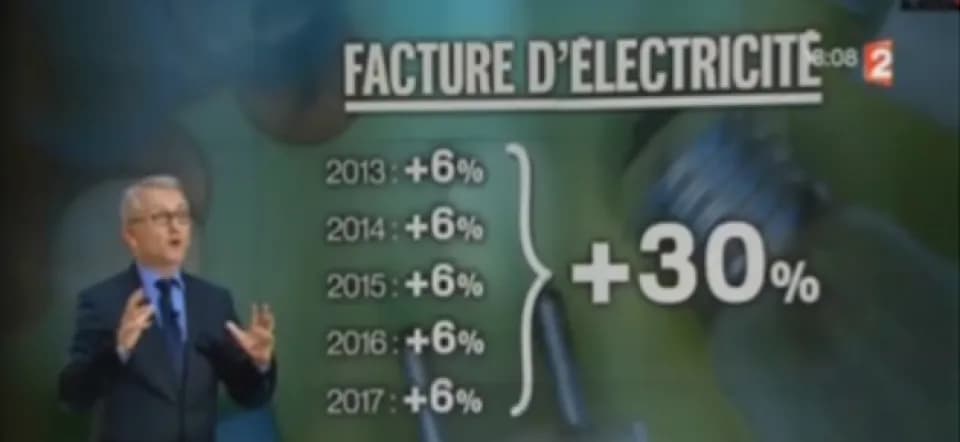
A politician claims that he had to raise taxes by 15% in the first year of his term and by 14% in the second—far better, he says, than his opposition rival, who had contemplated a 30% increase over two years. What are we to make of this? The classic mistake is to add the rates: 15% + 14% = 29%, which is indeed less than 30%. But let's take a numerical example. If the tax was €100 initially, it rose to €115 the following year. A further 14% of €115, or €16.10, then had to be added, bringing the final amount to 115 + 16.10 = €131.10. The overall increase was therefore 31.1%!
No need to have attended Polytechnique!
---------------------------------------
Rather than focusing on how much must be added at each stage, it is better to look at the factor we multiply by. Let p be the price of an item that rises by 20%. After the increase, the new price is as follows:
An increase of 20% therefore amounts to multiplying by 1.20. This number is the multiplier associated with a 20% increase. More generally, the multiplier associated with a rate of t% is 1 + t%. For example, the multipliers associated with an increase of 34% and a decrease of 12% are 1.34 and 0.88 respectively. Finding the rate from its multiplier is scarcely more complicated. If the multiplier is 1.125, the associated rate is 1.125 – 1 = 0.125, corresponding to an increase of 12.5%.