20 years on and still relevant!
-------------------------------------
One of the flagship initiatives of the Société française de recherche opérationnelle et d’aide à la décision (ROADEF) was to launch, 20 years ago, a competition led by an industry partner for operations researchers in academia.
The venture began with Bouygues in 1999. The latest edition of the competition, led by RTE, was launched in 2020. Air Liquide, EDF, Google, Orange, Renault, SNCF and Saint-Gobain have also contributed, offering operations researchers a broad range of industrial applications.
For industry and businesses, the goal is to gain access to scientific knowledge and expertise from around the world to help them solve real-world problems.
For the participating teams, the appeal lies in tackling difficult applied problems and developing methods that can efficiently process the datasets provided to them.
€45,000 up for grabs!
---------------------------
What are the key stages of the competition? Participation is open to everyone. An industry partner sets a problem—in English—together with a collection of datasets for an initial qualifying stage. The launch of the competition is announced at either the French national ROADEF conference or the European EURO conference. The first stage lasts around six months and is used to select teams. The next stage begins with the release of new, more challenging datasets, similar to those used in the final evaluation.
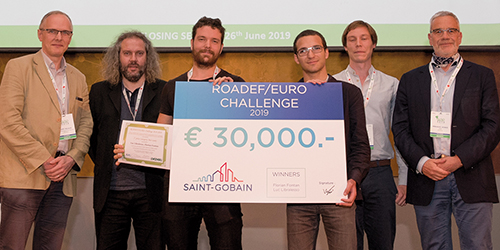
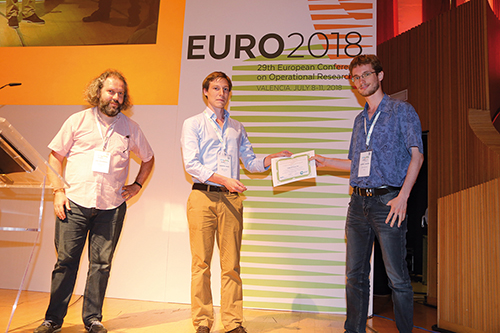
The competition lasts around a year and attracts an average of some 50 international teams in the junior and senior categories. The highlight is the announcement of the winners, who can receive prizes of up to €45,000. A special prize is also awarded as part of the competition to recognize participants’ scientific contributions.
More information: ****.
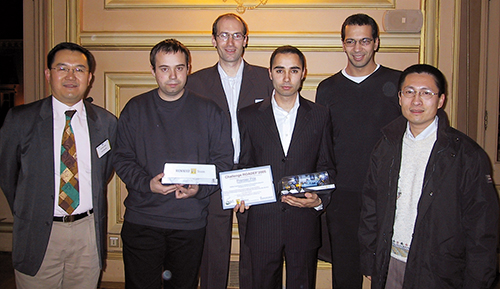
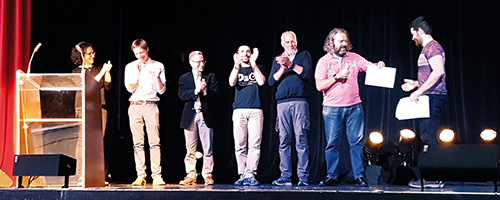
Awards ceremony for the 2005 challenge.
The 2018 competition: a case study
------------------------------------
The competition that ended in 2018 was led by Saint-Gobain, a French company specializing in materials production. The challenge was to find a way of cutting as many glass pieces of different sizes as possible from as few sheets as possible. The sheets could contain defects, such as air bubbles, but the pieces cut from them had to be entirely defect-free. Cutting rules and constraints related to production resources also had to be observed.
At first glance, the problem seemed simple and playful, but it resembled one of the archetypal hard problems in operations research, known as the bin-packing problem. The participating teams proposed a variety of approaches, using and combining different algorithmic tools to solve real-world instances efficiently.