When German submarines sank the ocean liner Lusitania in 1915, for example, killing 1,120 people, a painter and British Army lieutenant named Norman Wilkinson reportedly came up with the idea of camouflaging ships—not by blending them into their surroundings, but by doing the opposite and creating disruptive camouflage, or razzle dazzle (from the English dazzle, "to confuse").
Like a herd of zebras whose predators cannot tell them apart, this camouflage, designed to disrupt the aim of operators firing torpedoes, featured a variety of geometric patterns—hatching, triangles and quadrilaterals—in conspicuous black and white. These patterns created an optical illusion that prevented observers from identifying the type and dimensions of a vessel or estimating its speed and heading. It has been suggested that this trompe-l'oeil geometry, often painted by women from the American Women's Reserve Camouflage Corps, could mislead even the most experienced submariner by about 55°. An unexpected, but probably effective, application of geometry!
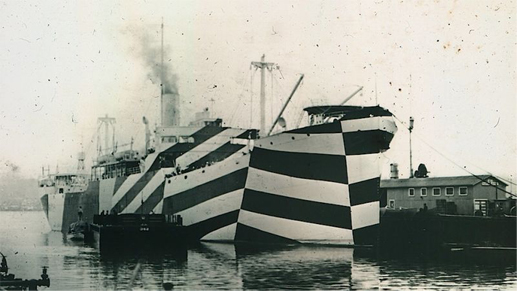
Razzle dazzle on the American ship USS West Mahomet.