In 2007, the highly respected American journal Science published an article by Peter Lu (see the references at the end of the article) and his doctoral supervisor, the renowned physicist Paul Steinhardt.
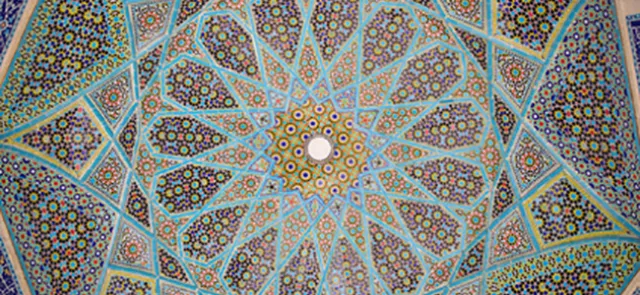
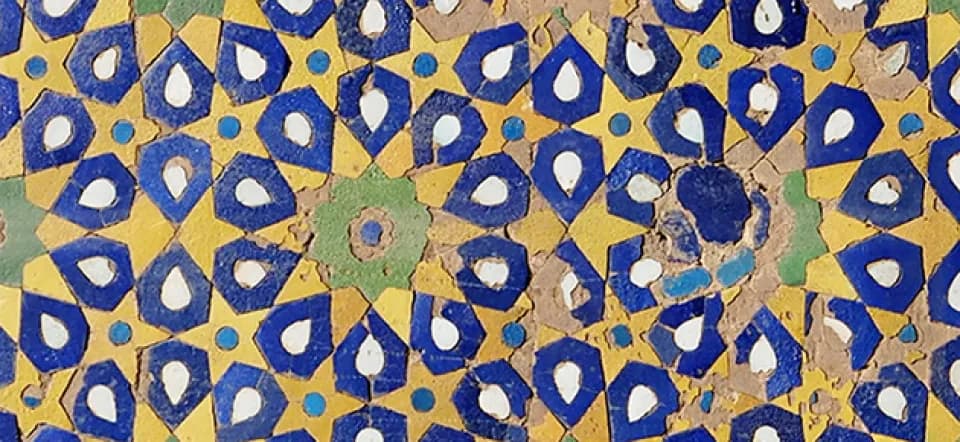
The first part of the article analyzes Persian pentagonal patterns using a hidden intermediate tiling made up of five types of decorated equilateral polygons, the girih tiles (or knot tiles). Building on this perspective, the second part claims to prove that traditional artists discovered nonperiodic tilings (or planar quasicrystals) five centuries before Western science.
The spectacular nature of the claim, combined with Steinhardt's prominence, led a great many newspapers around the world to pick up the article and simplify it almost beyond recognition (see Découpages et Pavages, Bibliothèque Tangente 64, 2018).
Yet the two claims put forward as original are highly debatable and fail to do justice
to earlier research, such as that of the American Jay Bonner and the Dane Emil Makovicky.
For lack of space, only the first claim will be dismantled here, though a few arguments will also be given against the second. Curious readers are invited to consult the references to learn more.