Philippe Carmona and Sylvain Gandon, of the Centre national de la recherche scientifique (CNRS), have developed a mathematical model to explain this phenomenon. Their research reveals the existence of a "winter" for so-called seasonal pathogens. During this period, they spread more slowly than they disappear from the population (top figure), thereby limiting the risk of a major epidemic. The researchers showed that the epidemic risk posed by a given pathogen depends on when it is introduced: if it appears during its "winter" or shortly beforehand, the risk is considerably reduced (bottom figure). This is the "winter is coming" effect. Thus, the probability of an influenza epidemic occurring in France in August is virtually zero. Understanding this seasonal dynamic should help in the fight against epidemics: taking action against a pathogen at the right time could help limit its spread.
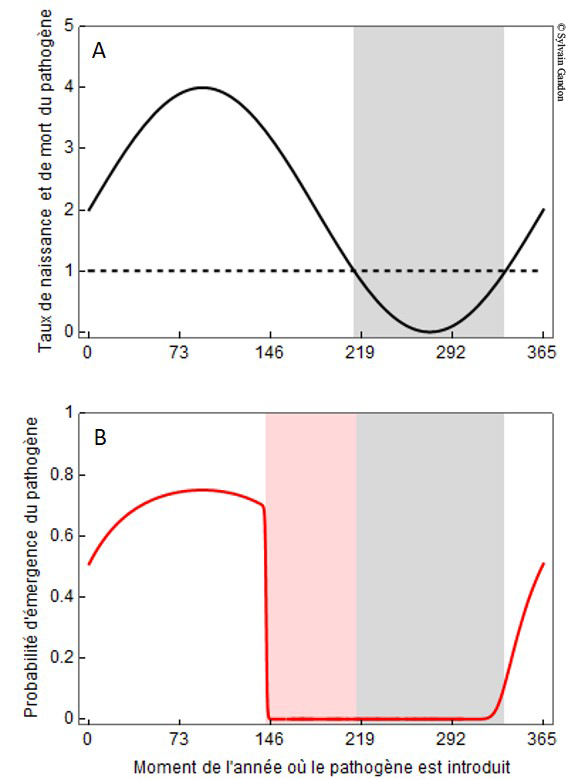
The top figure shows how the birth rate (the pathogen's transmission rate, solid line) and death rate (the recovery rate of hosts infected with the pathogen, dotted line) vary over time (the unit of time is one day). The dark grey area represents "winter" for the parasite (during "winter", the birth rate is lower than the death rate). The bottom figure shows the probability that the pathogen will emerge (red curve) as a function of the day of the year on which it is introduced. This probability is very low during "winter" (when the transmission rate is low), but also immediately before winter (red area). This very sharp fall in the probability of emergence just before winter is the "winter is coming" effect.