Infectious and viral diseases have afflicted humankind for millennia. Mathematics did not begin to take an interest in epidemics until the 18th century, when Europe learned from China about the deliberate inoculation of the smallpox virus. The question then was whether this precursor of vaccination should be encouraged. Using differential equations, the Swiss physician, physicist, and mathematician Daniel Bernoulli (1700–1782) calculated the increase in life expectancy afforded by population-wide variolation.
The most significant pandemic in history was the "Spanish flu," which killed 100 million people at the end of the First World War—around twenty times as many as Covid-19, according to the figures currently available. Together with the plague in India, it gave rise to the modern mathematical modeling of epidemics. The Lotka–Volterra predator–prey differential equations, which describe the dynamics of biological systems in which a predator interacts with its prey, also played a part (see Mathématiques et Biologie, Bibliothèque Tangente 42, 2011).
In the 1980s, the models were applied to AIDS. During the Covid-19 pandemic, their use surged in public-health policy decisions (see our feature "Covid-19, une approche mathématique," Tangente 194, 2020).
The SIR model
-------------
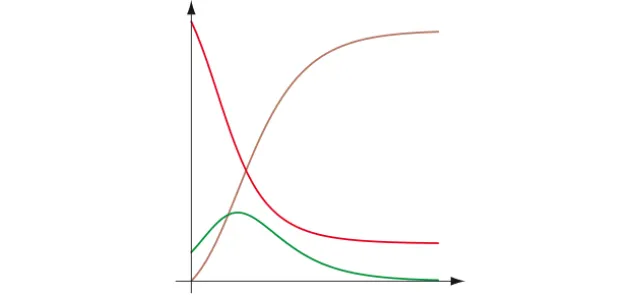
In 1927, biochemist William Ogilvy Kermack (1898–1970) and military physician Anderson Gray McKendrick (1876–1943) made incidence (the probability that an individual contracts the disease) proportional to prevalence (the proportion of individuals who are infectious), thereby introducing nonlinearity. The SIR model, whose foundations they laid, divides individuals into three categories representing their status with respect to the disease. These categories are known as compartments: "Susceptible" (S, "healthy"), "Infectious" (I, "infected"), and "Recovered" (R, "recovered"). The two scientists envisaged a model in which every parameter could vary. But computers did not exist in 1927. They therefore defined "simplified versions," hoping—unfortunately in vain—to find a way of expressing S, I, and R as analytic functions (functions expandable as power series near every point in their domains). The problem then took the form of a system of ordinary differential equations (ODEs) depending on a single variable: time.