



Interview
Interviews with mathematicians and personalities from the scientific world
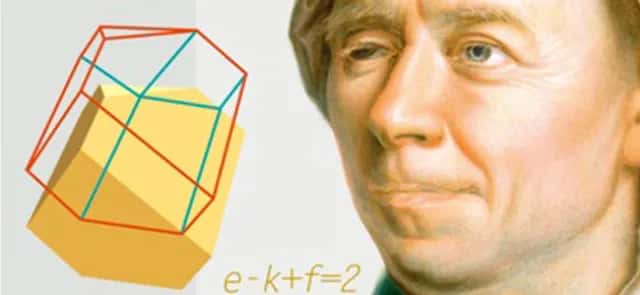
Geometric delights with Euler’s formula
Euler’s formula, a fundamental relation in mathematics, offers an opportunity to explore the properties of objects in three dimensions—and in higher dimensions as well. Along the way, we will encounter a classic of operations research: the simplex algorithm.

The people of the rational numbers
A brief imaginary, non-chronological history that attempts to answer a question less straightforward than it seems: are fractions numbers?

Proportionality: so crucial, so difficult
Proportionality arises in problems involving multiplication, division, and combinations of the two. Because it is difficult to learn, it poses challenges for teaching and has prompted extensive research in mathematics education.

Multiplying with rods | Tangente
Before the advent of modern technology, techniques or tools had to be devised to perform the basic calculations required by craftspeople, engineers and everyone else! From John Napier to Édouard Lucas, mathematicians distinguished themselves in this pursuit.
Mathematicians make progress on coloring
Coloring problems are often very simple to state and may appeal to many amateur mathematicians. Unfortunately—or perhaps fortunately?—they conceal deep difficulties that continue to tax the mathematical community. A new breakthrough was made recently.

An inventory of arithmetic puzzles | Tangente
Figurate numbers, which provide a visual representation of integers, form a wonderful bridge between geometry and arithmetic. Some properties in either field can be reformulated in the other, and vice versa! New questions naturally arise…
Three laws of error
Observations of celestial bodies are invariably subject to error. How can we choose the "most relevant" value from several measurements? Laplace, along with Legendre and Gauss, developed theories that ultimately led to the celebrated normal distribution.

Will the Sun rise tomorrow?
Should we live each day as though it were our last? The question is a fair one, given that in 1814 Pierre-Simon de Laplace put the probability of the Sun rising again the next day at 0.99999945…
Numbers or not?
Irrational numbers had a troubled beginning. Introducing roots of integers that are not perfect powers raised many questions about the nature and essence of numbers. Is a radical incommensurable with unity and its subdivisions a number?
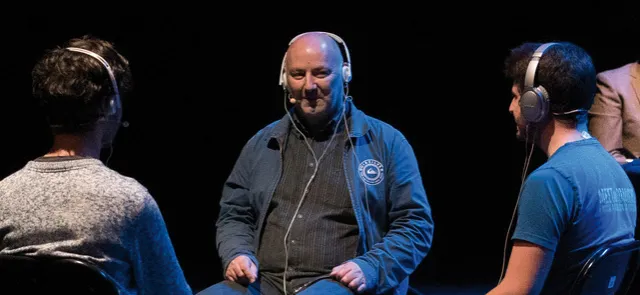
La Maison des mathématiques de l’Ouest - Article | Tangente
Activities that bring artists and mathematicians together to share mathematics with the public are flourishing across Pays de la Loire and Brittany. A Maison des mathématiques de l’Ouest was established to bring them together.
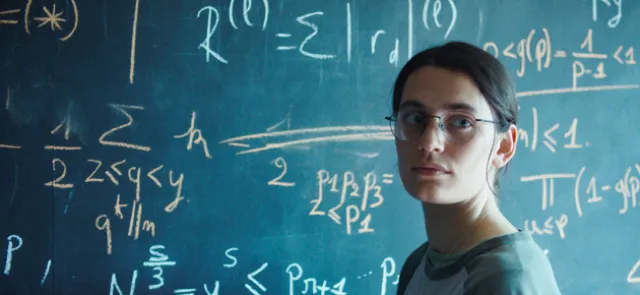
Marguerite's Theorem – Article | Tangente
Anna Novion's film Marguerite's Theorem had already won numerous prizes and awards before it even reached cinemas. Anna Novion, the director, and Ariane Mézard, the mathematician who advised her, agreed to answer Tangente's questions.

The many facets of counting | Tangente
The etymology of the French verb "dénombrer" is relatively transparent: as in the words "énumérer" and "numération", we can recognize the Latin root numerus, meaning number or quantity. To dénombrer is thus to seek an answer to the question "how many?"
Bienaymé–Chebyshev inequality in probability | Tangente
Summarizing a set of observations with a few key numbers is essential. But how much do these numbers tell us about the frequencies within particular intervals? The Bienaymé–Chebyshev inequality provides a first quantitative answer.

Maryna Viazovska on CultureMATH | Tangente
The CultureMath website, produced by the École normale supérieure, features an interview well worth reading. Mathematics teacher Nathalie Braun interviews Maryna Viazovska.

Some questions about sums of integers…
You might think that everything has already been said and done about adding two integers. Think again! That mischievous carry, which can ripple from one step of the calculation to the next, gives rise to difficult questions. This elementary algorithm still raises formidable problems.

The Pythagorean theorem before Pythagoras | Tangente
Pythagoras would never have accepted this result being named after him: he knew perfectly well that he had learned it on his journeys of study. As we shall see, it already existed in Babylon and India!

Bruno Falissard, biostatistician: interview | Tangente
Bruno Falissard is a psychiatrist, professor of biostatistics at Université Paris-Sud and director of the Centre for Research in Epidemiology and Population Health. He explains how statistics can help evaluate new therapies.

How maths helps evaluate drug efficacy | Tangente
More than ten years. That is the time that elapses between the discovery of a new molecule and the marketing of a product. Proving a drug's efficacy is a lengthy process in which statistics play an essential role at every stage of development.

ChatGPT and the mathematics of intelligence | Tangente
Who hasn't heard of ChatGPT? The feats of this artificial intelligence have sparked impassioned debate, along with fears and hopes for the future. To understand what it is all about, let's begin by exploring how this gigantic neural network works!

Modeling sports training with mathematics | Tangente
Modeling the relationship between performance and training is a delicate statistical problem. Seeking a mathematical model that links these two sets of data means thinking about sport and the potential effects of an athlete's efforts on their results.