



Interview
Interviews with mathematicians and personalities from the scientific world

Dividing inheritances under Islamic law
Dividing an inheritance may seem like a mathematical question of little interest. Yet al-Khwarizm devoted a large part of his work to it because he saw it as an ideal playground for algebra.

A century ago: equal access to the baccalauréat | Tangente
Exactly 100 years ago, girls' secondary schools were authorized to offer the same curriculum as boys' schools. Girls could now officially prepare for the baccalauréat there without having to take supplementary classes.

Maths-Vives: Mathematics takes on major challenges | Tangente
What role can mathematics play in tackling the societal challenges of today and tomorrow? The "Mathematics in Interaction" (Maths-Vives) research program aims to provide practical answers to this question.

Mathematics unleashed: passion and research | Tangente
As an amateur, where can you find topics to explore? How can you learn about a subject and keep abreast of the state of the art? Where can you meet people to exchange ideas with—or even find opportunities to publish? Here are a few pointers for anyone eager to take the plunge.

The joy of mathematical discovery: amateur mathematicians | Tangente
Christian Boyer, Vincent Thill, Jean Moreau de Saint-Martin and Philippe Fondanaiche—all passionate amateur mathematicians—agreed to answer our questions about how their interest in mathematics began and the activities they have developed in their favorite areas.
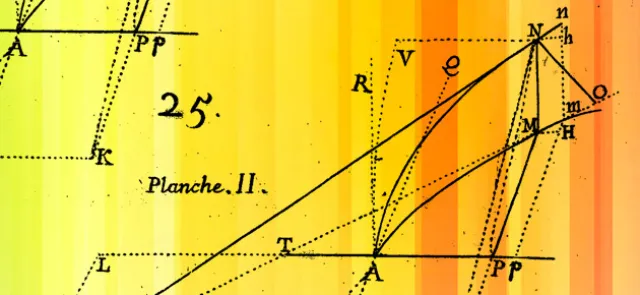
The geometry of curves
Alexis Claude Clairaut first came to the attention of learned circles through his book on curves of double curvature, presented to the Académie in 1729. He was only 16 at the time. The book was published in 1731, earning him election to the Académie des sciences at the age of 18.

Kepler, or the defeat of the circle
Kepler's first law states that planets follow elliptical orbits around the Sun. How can this be proved with the bare minimum of theory? To answer this question, physicist Richard Feynman produced a little gem of classical geometry applied to celestial mechanics.
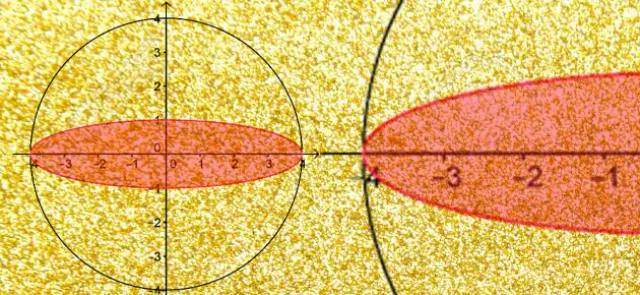
A question of circumference
You might expect calculating the perimeter of an ellipse—a fairly ordinary shape—to be straightforward. Yet it is a problem on which mathematicians have displayed extraordinary ingenuity. And in the formula contest, Ramanujan wins!
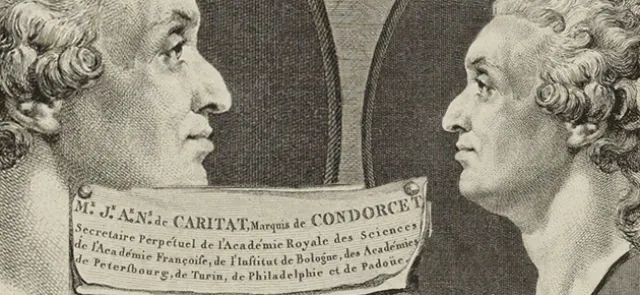
Condorcet judged by his peers | Tangente
Condorcet always took an interest in analysis, but accounts and assessments of his mathematical work varied widely. Although he bounced back after the Académie’s unfavorable judgment of his first paper, the 19th century proved much harsher.

Sophie de Condorcet, a figure of the Enlightenment | Tangente
Born around 1763, Sophie de Grouchy married Condorcet, whom she had met at the home of her uncle and mentor, President Mercier du Paty.

The one-cut theorem: any polygon in a single cut | Tangente
Can a polygon be cut from a sheet of paper with a single straight cut? Surprisingly, the answer is yes! More surprisingly still, this also applies to other objects.

Editorial
When our ancestors settled down, they encountered basic geometric shapes bounded by straight line segments: polygons. The Nile's regular floods thus made it necessary to develop geometric tools for reconstructing the land register, including the shape and area of cultivated fields.

Daniel Litt's probability problems
The young mathematician Daniel Litt currently holds a position at the University of Toronto. His research usually explores the interplay between algebraic geometry and arithmetic. Yet in recent months, he has attracted attention in an entirely different field, even earning an interview with the renowned online publication Quanta Magazine.

Integer polygons
The discovery that so simple a figure as a square cannot have both sides and diagonals of integer length troubled several great scholars of antiquity. Can polygons with this property nevertheless be found? This seemingly innocent question continues to open up new avenues of research today.

A (good) Babylonian approximation
The Babylonians have always been renowned as brilliant mathematicians, and the clay tablets that have survived sometimes bear dazzling witness to their skill.

Combinatorics on words and music | Tangente
Combinatorics on words is an area of mathematics that has proved particularly fruitful for studying certain musical phenomena, especially the rhythmic features of African and Malagasy music—so much so that a computer can even recreate them!
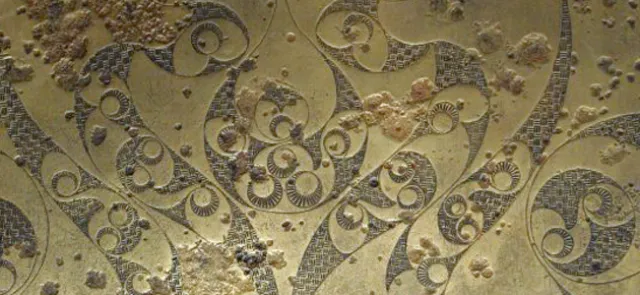
Geometry in Celtic art | Tangente
Celtic art is constructed according to mathematical and geometric principles. Ethnomathematics helps us identify and analyze the geometry that underpins this symbolic art.

Nash and penalty shootouts: maths article | Tangente
When a penalty is taken in football, the player wants to put the ball in the net; the goalkeeper has to stop him. Can mathematics help maximize the chances of scoring—or of saving that fateful shot? The affirmative answer illustrates the work of John Nash.

Statistics, what else? A mathematics article | Tangente
Among the branches of mathematics applied to sport, statistics holds a prominent place. It is used to analyze large datasets—big data—to combat doping, and in media coverage of sport, typically for questions concerning the Olympic Games.
My thesis in Tangente
Geometric shapes can be associated with different pieces of music to shed light on their structure. This can be done by defining a distance between musical events using the discrete Fourier transform applied to the bars of a score.