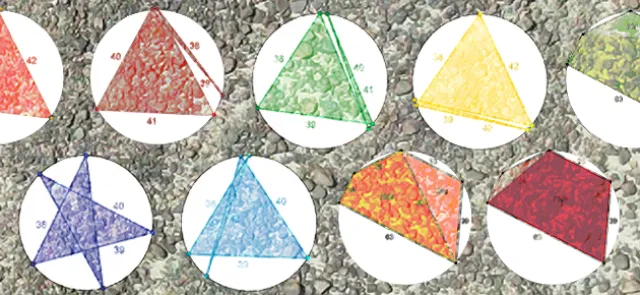
The family soon expanded to include polygons of many different shapes. We owe their nomenclature, still in use today, to Greek mathematicians. They ambitiously set about constructing this multitude of polygons under the constraint of using only an unmarked straightedge and a compass. It was not until the 19th century that mathematicians proved that only certain regular polygons can be constructed in this way. The heptagon is the first regular polygon that cannot be constructed; Archimedes nevertheless devised an exact construction by dispensing with the straightedge-and-compass constraint.
For centuries, polygons—seemingly very simple figures—have fascinated generations of leading mathematicians, including Heron, Ptolemy, Brahmagupta, Viète, Kepler, Girard, Euler, Gauss, Steiner and many others. What is simple is not necessarily elementary, nor is what is complicated necessarily complex.
Artists such as Leonardo da Vinci and Albrecht Dürer also come to mind, as do the engineers who designed fortifications from the 16th century onward. These engineers took a new approach to constructing regular polygons, not because they lacked mathematical knowledge, but because they had mastered a practical approximation for builders.
The very definition of polygons evolved over time, reaching its abstract form in the 20th century thanks to the discrete geometer Branko Grünbaum and thereby encompassing the many "pathological cases" that had arisen throughout its history.
We shall set triangles aside, not because they are the most elementary polygons, but because we have already covered them in a previous special issue (Le triangle, Bibliothèque Tangente 24, 2005). But quadrilaterals have plenty to offer as well: you will discover many surprising properties and see the unexpected emerge from the elementary—or what is assumed to be so.
This field of study, which remains relevant today, requires no special knowledge, "merely" curiosity and imagination. The American mathematician David Peter Robbins thus sought, using nontrivial methods, to generalize the formulas for calculating areas established by Heron of Alexandria and Brahmagupta for triangles and quadrilaterals.
Polygons are the quintessential example of a subject that it would be presumptuous to call trivial, and they call for a degree of mathematical humility, so great is the contrast between their apparent simplicity and the richness of their properties.