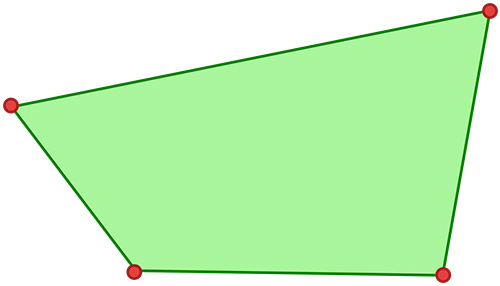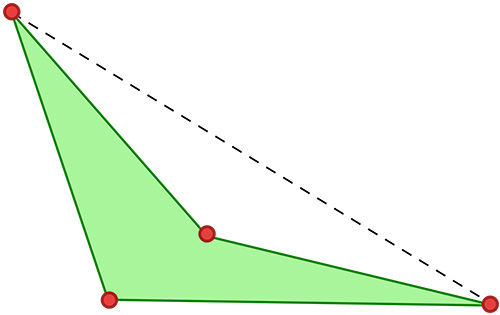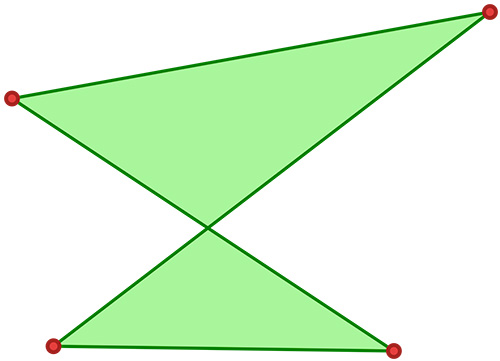


The historian of mathematics Siegmund Günther (1848–1923) asserts that Albert Girard of Lorraine (1595–1632) had already given a general definition of the polygon in his 1626 table.


Articles recommended for you.

Behind this phrase lies a famous mathematical challenge that brought together two brilliant minds on a quest to uncover the hidden order within chaos. It was the birth of a beautiful love story — and of a new branch of mathematics!

In 1933, Hungarian mathematician Eszter Klein posed an apparently elementary geometry problem to a group of young colleagues. It would lead to the birth of a new field of mathematics, discrete geometry, and... a marriage.

While the geometry of triangles and quadrilaterals has been studied in detail for many centuries, the geometry of pentagons has only recently begun to be explored. Let's follow in the footsteps of Heron, Brahmagupta and Robbins.

Some constructions impossible to achieve with straightedge and compass become possible using origami… but not all of them! Paper folding also lets us revisit several questions of concurrency or collinearity, and reflect on the construction of polygons.
Discussion
Sign in to post a comment and talk with other readers.
No comments yet. Be the first to respond.