All about triangles: types and names | Tangente
All about triangles
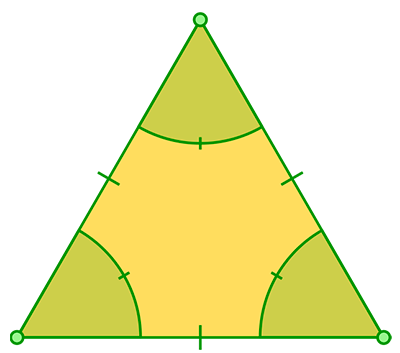
Thanks to its simplicity, the triangle is surely the king of polygons. As its name suggests, it has three angles and therefore three sides.


Thanks to its simplicity, the triangle is surely the king of polygons. As its name suggests, it has three angles and therefore three sides.


Articles recommended for you.

For the familiar convex quadrilaterals, the classification criteria are, first, whether the sides are parallel, then whether their lengths are equal, and finally whether there are any right angles.

For many people, the rhombus—originally called a "rhomb" (see In Brief, "The origin of the rhombus"; the associated adjective is still "rhombic")—is characterized by its acute angles pointing upward and downward. Yet, as Euclid already observed, this quadrilateral is defined by the equal lengths of its sides. Its ability to form tilings accounts for its use in architecture and decoration.

The problem of dissecting an obtuse triangle was proposed by Martin Gardner in Scientific American.

Two postulates in Euclid's Elements embody the ideal conception of the straightedge and compass inherited from Plato's realm of Ideas. The Alexandrian scholar built much of plane geometry—and the constructions he bequeathed to us—on these two postulates.
Discussion
Sign in to post a comment and talk with other readers.
No comments yet. Be the first to respond.