



From various angles
The mention of polygons generally refers to the geometric figures of our tilings, often regular. Their apparent simplicity might make one believe that their study is without difficulty, therefore without interest. However, certain operations, such as checking convexity or differentiating vertex and side intersection for a crossed polygon, remain complex. A first task is therefore to seek a definition general enough to bring together polygons with exotic names – acoptic, aploic or isotoxal – into a single family. The question then arises whether one can obtain from all their characteristics a typology that makes it possible to classify and construct them.
All articles in this folder

Editorial
When our ancestors settled down, they encountered basic geometric shapes bounded by straight line segments: polygons. The Nile's regular floods thus made it necessary to develop geometric tools for reconstructing the land register, including the shape and area of cultivated fields.

Polygon names: etymology and nomenclature | Tangente
The word "polygon" comes from the Greek poly, "many", and gonos, "angle, corner", which some authors link to gonou, "knee", the body's archetypal angle.

All about triangles: types and names | Tangente
Thanks to its simplicity, the triangle is surely the king of polygons. As its name suggests, it has three angles and therefore three sides.

Quadrilateral types and names | Tangente
For the familiar convex quadrilaterals, the classification criteria are, first, whether the sides are parallel, then whether their lengths are equal, and finally whether there are any right angles.

What is a polygon? A rigorous definition | Tangente
The definition of a polygon seems intuitive and obvious. Yet when we try to pin down this mathematical object more precisely, several definitions are possible, and the most recent ones may defy common sense.

Albert Girard, pioneer of classification | Tangente
The historian of mathematics Siegmund Günther (1848–1923) asserts that Albert Girard of Lorraine (1595–1632) had already given a general definition of the polygon in his 1626 table.
A few constructions
It is always useful to know how to construct the first constructible regular polygons with straightedge and compass. These procedures directly provide methods for calculating the various lengths in the figure.

Regular polygons
Regular polygons are particularly harmonious, thanks to their symmetries. At first glance, one might think they had long since yielded all their secrets. Yet the notion of duality reveals a wealth of surprises.

The pitfalls of polygon convexity | Tangente
The word convex comes from the Latin convexus, meaning "rounded". What does this mean mathematically?

Inside and outside a polygon | Tangente
How can we systematically determine whether a point lies inside or outside a polygon? Several algorithms, including the "ray-crossing method," solve this problem.
Convex quadrilaterals
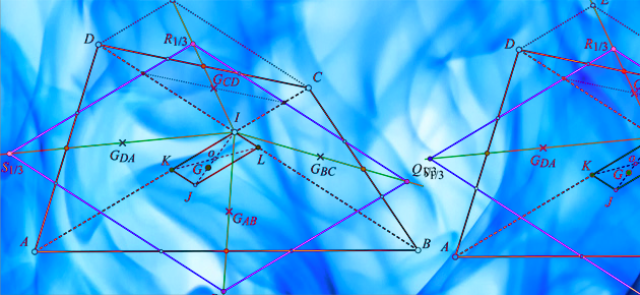
Three sides completely determine a triangle, up to orientation. With four sides, infinitely many polygons can be constructed. Nevertheless, many general properties can be established for arbitrary convex quadrilaterals.