-
A polygon, then, is simply a figure with several angles. The word first appeared as "poligone" in Pierre Verney's 1520 Succinte, briefve et compendieuse collection géométrale. The root gon also occurs in "diagonal", a line segment joining two non-adjacent vertices and crossing (dia, "across") an angle (gonos). The term is attested from the late 13th century.

Naming conventions
---------------
As a rule, a polygon's name is simply its "number of angles" with the suffix gon added.
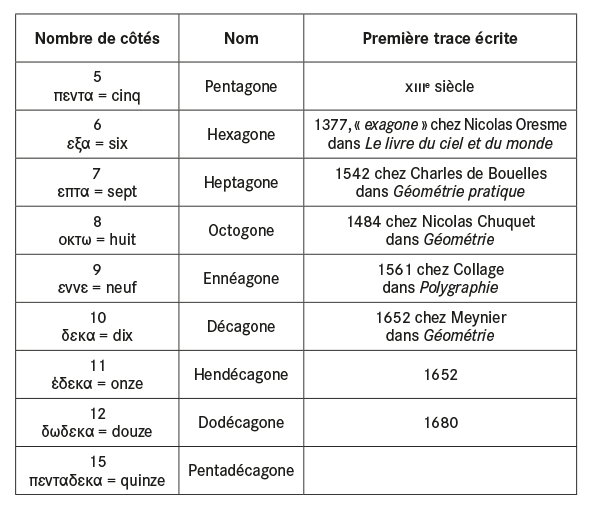
It is worth noting that the term "nonagon", sometimes found in the literature, is incorrect because it is a Latin-Greek hybrid. "Enneagon" is therefore preferable! Beyond twelve sides—which is fairly rare—the expression "n-gon" is often more convenient and explicit, allowing the circle to be viewed as an "infinity-gon".
The transition from Greek to Latin
-----------------------
For the most common polygons, with three or four sides, the nomenclature took a new turn in the late Middle Ages: Latin joined Greek, with latus ("side") replacing gonos ("angle"). Only the language of the number used to describe the polygon changed, since, fortunately, a polygon has as many angles as sides (Euler's formula).
Thus, in 1377, Nicolas Oresme called a three-sided polygon a trigon in Le livre du ciel et du monde. In everyday usage, however, "triangle" is preferred. Derived from the Latin triangulum, it is attested as early as the 1270s in Jean de Meun's Le Roman de la Rose, where it does indeed denote a figure with three angles.
Oresme also called a figure with four angles a tetragon (Ethique, 1370). The corresponding term of Latin origin is "quadrangle", which appeared in the 13th century, but "quadrilateral" is preferred, from quadri ("four") and latus ("side"). It first occurs in Jaques Peletier du Mans's Algèbre (1554).
The five-pointed star is called a "pentagram", from the Greek penta ("five") and gramma ("letter"). The term "pentacle", sometimes "pentalpha"—with four vertices forming an "alpha"—is a synonym for pentagram used mainly in occultism. The same word-building pattern gives us the hexagram, a six-pointed star.
For terminological consistency, H.S.M. Coxeter uses the term "digon" for a degenerate polygon with two sides.
Reference: Centre national de ressources textuelles et lexicales (**www.cnrtl.fr**).