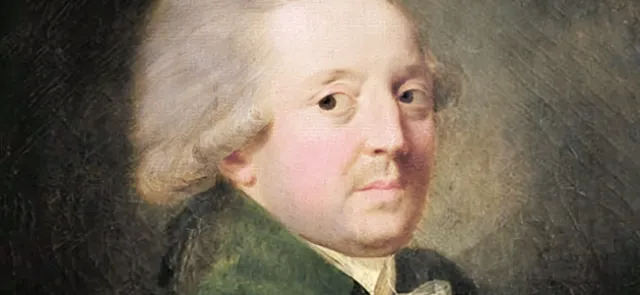
Condorcet is now recognized as one of the great pioneers of "social mathematics" (see the article "From political arithmetic to social mathematics"). Yet an entire area of his scientific activity, concerning mathematical analysis, has largely been forgotten, and contemporary mathematicians find his writings on integral calculus difficult to read. Nevertheless, this work occupied him for much of his life, and mathematical analysis played a far from incidental role in his philosophical thought.
A formative failure
------------------
Condorcet’s earliest work on mathematical analysis dates from when he was eighteen. After patiently preparing his Essai sur une méthode générale pour intégrer les équations différentielles à deux variables, the young native of Ribemont submitted his paper to the Académie des sciences. It is worth emphasizing that one of the missions of this institution, then barely a century old, was to inspire new vocations and to seek out and encourage young talent. This mission was often taken seriously, though that did not mean the referees assigned to assess submissions were indulgent. In Condorcet’s case, the two referees were the academicians Clairaut, some of whose results on curves are still taught today, and Fontaine, a specialist in functions of several variables. Their assessment of Condorcet’s work was extremely harsh: they considered the paper to "lack care and clarity" and, above all, found its author wholly unaware of previously established results. Condorcet learned from the rejection: his next work, Du calcul intégral, submitted to the Académie four years later, bore this out. For one thing, its bibliography abounded in references to papers by Fontaine, d’Alembert, Euler and others. For another, he chose his subject accordingly: at the time, the wave equation was attracting the attention of many scientists. Its first systematic study had been put forward by d’Alembert in the 1740s, and it was used in the paper that earned him the Berlin Academy Prize in 1746.
His new work was received far more favorably. Its referees happened to be d’Alembert, the leading French analyst of the day, and Bézout, the celebrated author of mathematics textbooks: "The nature of the subjects addressed in this Work scarcely allows an extract to elaborate further upon the subtlety and depth of insight underlying the methods used by the Author & most of which are his own. Not only does this Work reveal in the Author a very extensive knowledge of calculus, & one rarely found to such a degree at so young an age; it also heralds the greatest talents, & those most worthy of encouragement through the Approval of the Académie. Done in Paris, this 22 May 1765. Signed, D’ALEMBERT and BEZOUT."
Nevertheless, this work cannot be recommended to modern readers. Although Condorcet takes pains to describe his work precisely, the term "finite integral," or integration in finite terms, no longer has its former meaning: it refers a priori to obtaining a combination of algebraic, exponential and logarithmic functions. Ingenious though his constructions are, they appear laborious to eyes accustomed to the methods of the late 18th and, above all, the 19th century.