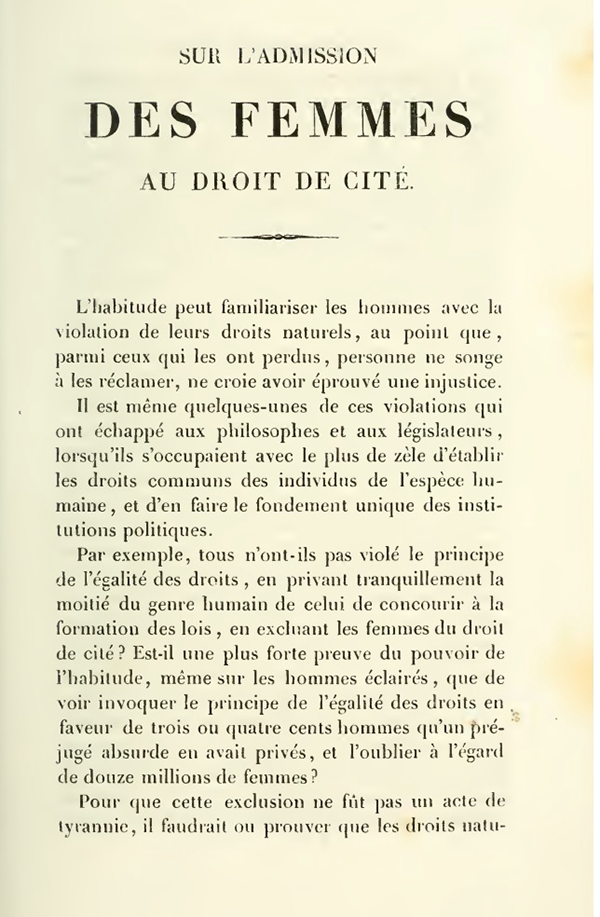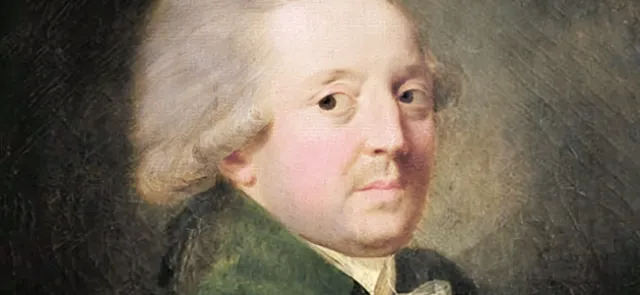
During the Revolution, he was one of the few men to publicly champion political equality between the sexes, publishing Sur l’admission des femmes au droit de cité (1790).
This extension of citizenship to women rests on the idea that political rights are grounded in natural rights. Since a woman is a "sentient being, capable of reasoning and of having moral ideas" just as a man is, excluding women would require "show[ing] that she is incapable of exercising them [political rights]." Condorcet sets out to refute this claim. He first rejects the argument that women should be confined to the private sphere, maintaining that the private and public spheres are not at odds, since personal integrity and civic engagement reinforce each other. He then dismisses arguments about women's physical or intellectual abilities.
In his view, a proper understanding of the nature shared by men and women, beyond the artificial distinctions created by society, shows that no social or natural difference between the sexes justifies denying women political rights.