



Condorcet, a Committed Mathematician
If Condorcet is known as the great defender of public education, we often forget that he was first and foremost a mathematician. His work in analysis was praised by the Academy of Sciences, even if it must be acknowledged that judgments on his mathematical work were sometimes rather negative. This is undoubtedly largely due to his attempt to found a social mathematics, that is, to apply probabilities to human questions, particularly electoral ones. This stems from a desire to use mathematics to eliminate reasoning errors and prejudices from our actions. It was also from this perspective that he advocated for popular mathematics education just as he opposed the magical thinking surrounding Mesmer's experiments. In the same way, he was politically engaged for women's suffrage and for the abolition of slavery. Condorcet is the author of a rich body of thought where mathematics always serves as a substrate.
All articles in this folder
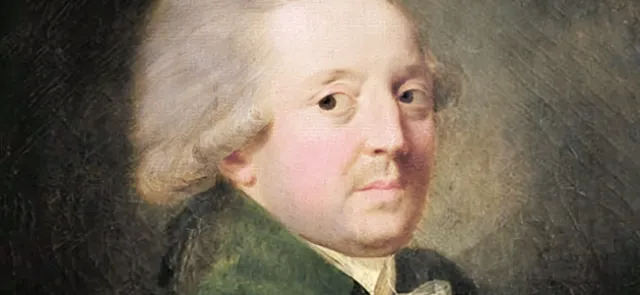
Condorcet: a true Enlightenment mathematician | Tangente
Although Condorcet is best known today as a philosopher, he began his career as a mathematician. A precocious polymath, mathematics also led him to politics and philosophy.

Julie de Lespinasse and d'Alembert's salon | Tangente
Julie de Lespinasse, a highly cultured woman and close friend of d’Alembert, opened a salon in 1764 at the corner of rue de Bellechasse and rue Saint-Dominique.

Condorcet and the transmission of knowledge | Tangente
At the end of the preface to his Essais d’Analyse, Condorcet includes the Latin quotation "vice fungar cotis, acutem reddere quae ferrum valet, exsors ipsa secandi," from Horace’s Ars Poetica (line 305).

Sophie de Condorcet, a figure of the Enlightenment | Tangente
Born around 1763, Sophie de Grouchy married Condorcet, whom she had met at the home of her uncle and mentor, President Mercier du Paty.
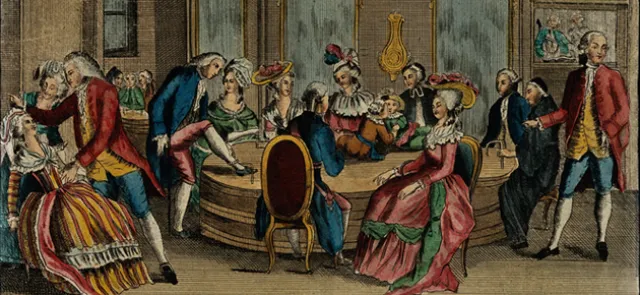
Condorcet, pioneer of scientific skepticism | Tangente
Responding to the vogue for Mesmerism—what we would now call a pseudoscience—Condorcet may be regarded as a pioneer of scientific skepticism. His analyses remain as relevant and timely as ever.

Condorcet: mathematics for citizenship | Tangente
Condorcet embraced the ideals of the French Revolution and played an active part in the educational reforms set in motion by the Revolution.

Condorcet’s project for a numeral system | Tangente
During the French Revolution, the National Constituent Assembly decided to standardize weights and measures and entrusted several scientists, including Condorcet, with determining the length of what would become the metre. In the same spirit of rationalization and simplification, Condorcet turned his attention to the education of young children.
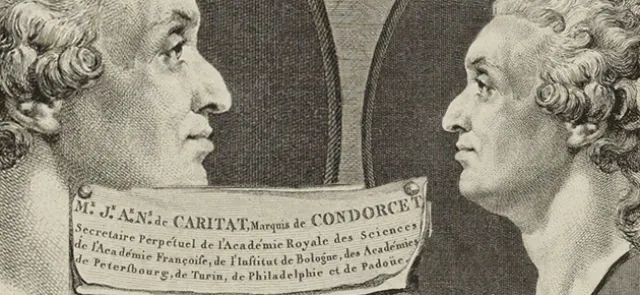
Condorcet judged by his peers | Tangente
Condorcet always took an interest in analysis, but accounts and assessments of his mathematical work varied widely. Although he bounced back after the Académie’s unfavorable judgment of his first paper, the 19th century proved much harsher.

From political arithmetic to social mathematics | Tangente
Condorcet is not the first to seek to apply mathematics to public life. Yet he sets himself radically apart from his predecessors—and lays claim to that distinction—by coining the phrase "social mathematics."
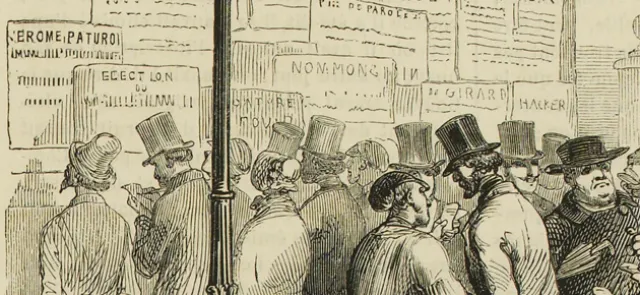
Condorcet, theorist of electoral procedures | Tangente
Condorcet is recognized as one of the pioneers in the theory of electoral systems, alongside his contemporary, the Chevalier de Borda. Both thinkers brought a fundamental idea to light: the method used to elect a candidate has a decisive influence on the outcome.

Condorcet's paradox explained | Tangente
From Lewis Carroll to Kenneth Arrow, the famous Condorcet paradox has generated a great deal of discussion.

Condorcet, champion of women's suffrage | Tangente
A few years before the Revolution began, Condorcet was the first French writer to make the case for women's voting rights in his Lettres d’un bourgeois de New-Haven (1787).

Condorcet’s Enlightenment fight against slavery | Tangente
In his Réflexions sur l’esclavage des nègres (Reflections on Black Slavery), published in 1781 under the pseudonym Pastor Joachim Schwartz ("black" in German), Condorcet opposed slavery, which he regarded as a fundamental violation of human rights, and denounced the contradictions and injustices bound up with the enslavement of Black people.

Condorcet and physiocratic political economy | Tangente
Condorcet's ideas were influenced by the Physiocrats, who championed free trade and restricted voting rights to property owners.