For thirty years, the association Femmes et mathématiques has campaigned to encourage more women to pursue science and make it easier for them to enter related careers.
The situation and the association
===========================
What is your assessment of the situation?
Since 1995, the proportion of girls in the final year of the science track has risen, but it does not exceed 46%. At university, women account for 58% of students but are a small minority in science (37.5%), particularly in the fundamental sciences, where they make up only 28%. In engineering schools, their share rose to 28% in 2013; it has since stagnated and is even declining in some sectors.
Women remain just as underrepresented in scientific and technical careers, even though these careers are fascinating and offer a wide range of opportunities at every level, in both the public and private sectors.
Computing is a relatively new field, so the scarcity of women in its professions may seem surprising. Does the word "geek" have no feminine form?
Thank you for asking! It gives us an opportunity to draw attention to this field. About forty years ago, women were well represented in computing courses and careers. Since then, however, their share has declined alarmingly. Women accounted for 30% of computer engineers in the late 1980s, but that figure has plummeted and is now approaching 10%.
Boys rushed into the field with the advent of personal computing, creating a world perceived as rather hostile—and discouraging girls from entering it.
There is a great deal of discussion about sexual harassment at the moment. Is this also a factor in girls' educational choices?
It is mainly the many sarcastic remarks made in class and exercises biased against women that can unsettle girls and discourage them from entering courses in which boys are overwhelmingly in the majority.
Is your primary aim to improve individual educational and career paths, or is there also a national issue at stake?
Our main concern is individual educational and career paths. Stereotypes restrict educational choices: girls do not enter professions for which they could qualify. We are, however, fully aware of the national and international importance of women's participation in scientific professions: we can no longer afford to do without the skills of half of humanity. Yet demand for change is stronger among businesses than in the political world…
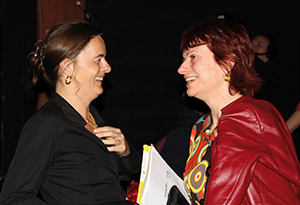
Alice Guionnet, of the Académie des sciences,
and Sylvie Méléard, a professor at the École polytechnique.
Some initial explanations
======================
Is society solely responsible for this imbalance? Some claim that there may be purely biological reasons…
Proponents of this biological determinism overlook recent neuroscience research: the brain is an organ that constantly forms new circuits and changes in response to experience and learning. Moreover, the status of different subjects varies from one period to another. In France in past centuries, literature, Latin and Greek were the most highly valued subjects and were reserved for men. Unlike in France, women with doctorates in "science, maths and computing" outnumber men in Italy and Portugal. These arguments decisively sweep aside the biological explanation: the human brain does not depend on time or place! The main explanations are social gender stereotypes and the lack of "role models." By stereotypes, we mean schematic, sweeping representations. They make the different, hierarchical roles assigned to women and men appear natural and normal. They are drip-fed by families, schools and the media… They also affect academic subjects by imposing a hierarchy on them. From early childhood, girls are exposed to numerous stereotypes suggesting that mathematics and computing are not for them. For example, a recent advertising campaign by the magazine l’Étudiant depicts a woman headed for a career in social services, while men represent the grandes écoles and the careers of the future.
Since you began your work, have you seen stereotypes recede?
On the contrary, we find stereotypes far more prevalent, as the example of toys shows. Our work can help raise awareness.
**
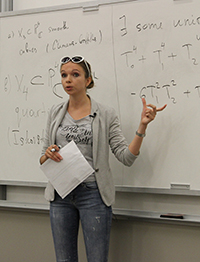
**Alena Pirutka, of the Courant Institute (New York, United States), studies the birational properties of algebraic varieties.
A wide range of grassroots initiatives
=====================================
What conclusions do you draw from your initiatives? For example, from organizing the "Girls and maths: a brilliant equation!" days [see box] or the "Meetings for young women mathematicians"…
These initiatives, which are reserved for girls, aim to make them aware of the impact of gender stereotypes and introduce them to women in a variety of mathematics-related professions. This gives them time to reflect together, without boys looking on. It helps them gain confidence and see that no path is closed to them.
We also visit schools and speak to whole classes, so we address girls and boys alike. We are often accompanied by women academics or engineers, preferably young ones. The girls thus meet "role models" with whom they can have meaningful discussions and whom they can identify with.
The Forum for Young Mathematicians is intended for women and men currently working on their doctorates or who have recently completed them. Organized with the Mission pour la place des femmes du CNRS [Centre national de la recherche scientifique], it gives these young people an opportunity to present their research and benefit from the expert advice of established women mathematicians.
**
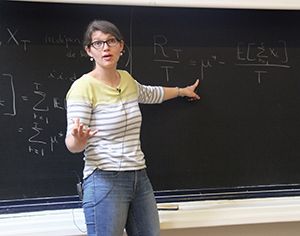
**Émilie Kaufmann works on statistics and machine learning at the University of Lille.
Changes that are not always welcome
=====================================
Do you think ending coeducation would be a solution?
Coeducation is too important an achievement to abandon. It is a necessary but not sufficient condition for progress towards equality: it must be actively supported, and that requires the political will to ensure that all education staff receive proper training on gender equality.
Do you think the baccalauréat reform, which abolishes the L, ES and S tracks, will affect girls' choice of mathematics? Can the Villani–Torossian report, which has just been submitted to the government, change the landscape?
We do not think the baccalauréat reform will change very much. The combinations of options offered to students will de facto recreate the tracks. Measure 19 of the report, however, recommends training teachers in gender equality. We have been calling for this for years! We hope it is actually implemented.
[Editor's note: Measure 19 of the report proposes: "Train teachers and supervisory staff in issues relating to gender equality in mathematics (gender stereotypes, career guidance, achievement, etc.)."]
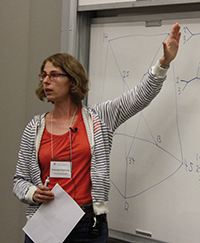
Hannah Markwig (University of Tübingen, Germany) works at the interface between tropical geometry and enumerative geometry.
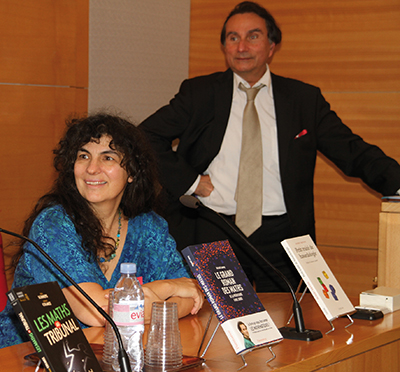
Leila Schneps (pictured here with Gilles Cohen) earns a commendation
in the Tangente High School Students' Prize for her book les Maths au tribunal (Le Seuil, 2015).