



Diagrams for solving
A picture is worth a thousand words! The power of images also lies in what they allow us to convey information. The diagram thus becomes a tool for thinking and problem-solving. Mathematicians have vied with each other in imagination to visualize data, make their results "jump out", and even justify them. Proofs without words, diagrams, Venn diagrams, trees, Karnaugh maps, nomograms and other modes of representation are all visual supports that have allowed a simplified view on all areas of mathematics.
All articles in this folder

The tree that hides the forest
Trees are often used to represent mathematical reasoning. Here are a few examples.
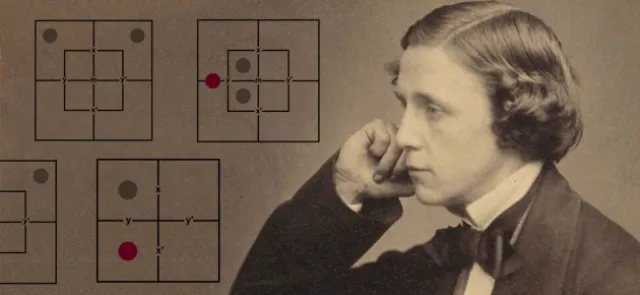
Lewis Carroll's diagrams
Lewis Carroll is known worldwide as the author of Alice's Adventures in Wonderland. Behind the pseudonym was Charles Lutwidge Dodgson (1832–1898), an Oxford mathematics lecturer with a passion for logic.
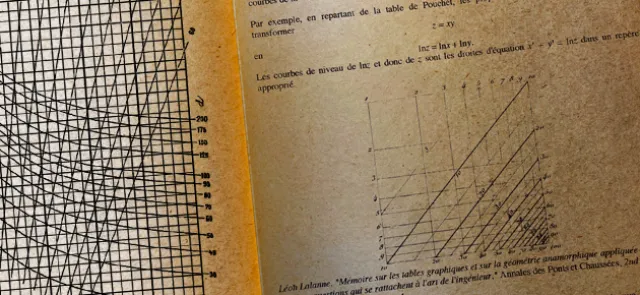
Nomograms
Arithmetic and geometry, the two traditional branches of elementary mathematics, come together in nomograms. But what exactly does this term, evidently derived from Greek, mean? What are nomograms used for, and how are they designed?
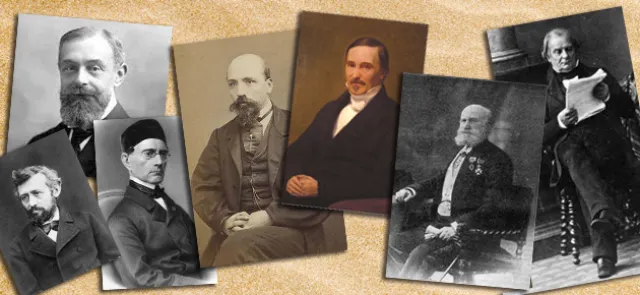
Graphical statics
Have you heard of "graphical statics"? Rooted in mathematics, particularly geometry, it is the art of balancing the forces acting on a body… without any calculations. Surprisingly, the discipline originated long before vectors were introduced!

Voronoi cells | Tangente
How a London doctor used Voronoi diagrams to combat cholera.

Mary Everest Boole: Forming mental images | Tangente
For Mary Everest Boole, a graphical approach is essential to teaching.

Graphs in literature | Tangente
The Oulipians have also explored the use of graphs and trees in literature.

Proving without saying a word
No drawing or diagram can ever replace a "proper" proof, but both can help make a proof self-evident. In this respect, proofs without words, so beloved of mathematicians, are a fine exercise in style. Some have become classics of the genre.