Trees for probability concepts…
------------------------------------------
A fairground game involves randomly choosing one of three identical-looking boxes. They contain three, two, and one token respectively; all the tokens are silver except for one gold token in each box.
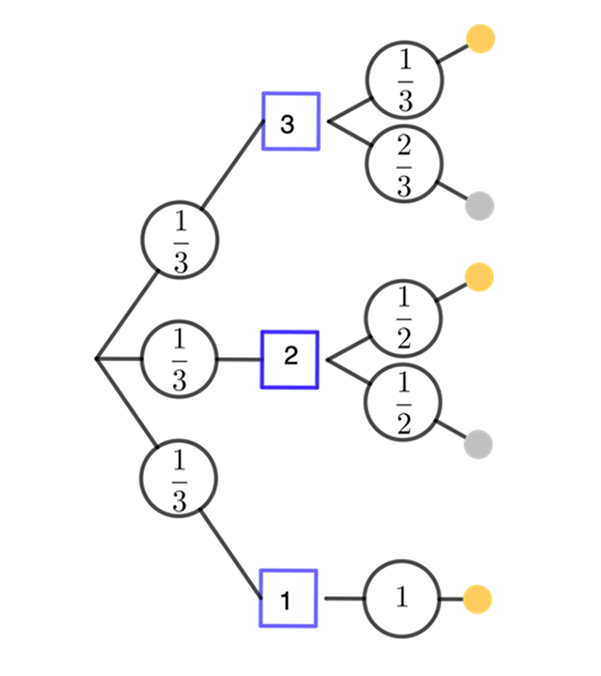
A two-level tree showing the possible outcomes (the box at the first level, followed by the token color). If the box containing three tokens is selected, for example, the probability of the outcome "gold token" is 1/3, while that of "silver token" is 2/3.
By providing a visual representation, the probability tree highlights the concept of conditional probability and makes its definition easier to grasp. For two events A and B, P(A and B) = P(A)×PA(B), where PA(B) is the probability of B given A. In this example, the probability of the outcome "three-token box and gold token" is indeed (1/3)×(1/3).
To calculate the probability of drawing a gold token, we get
P("gold token") =
We can now tackle a question such as this: given that the token is gold, what is the probability that it came from the box containing two tokens? We can then sketch a new tree with the branches reversed.
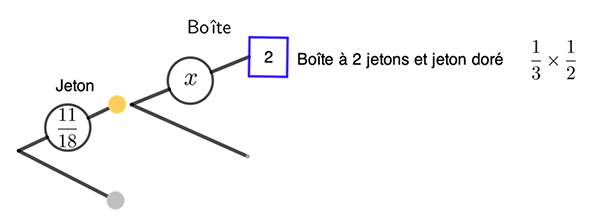
The required conditional probability x is then namely 3/11.
Through this visual representation, the probability tree helps introduce Bayes' formula. It is a teaching tool.
Here, for example, with two events A and B, the formula would simply be , where denotes the complement of A.
References
• Des statistiques aux probabilités (From Statistics to Probability). Bernard Parzysz, Repères IREM 10, January 1993.
• Les graphes (Graphs). Bibliothèque Tangente 54, 2015.
… and for counting
-------------------
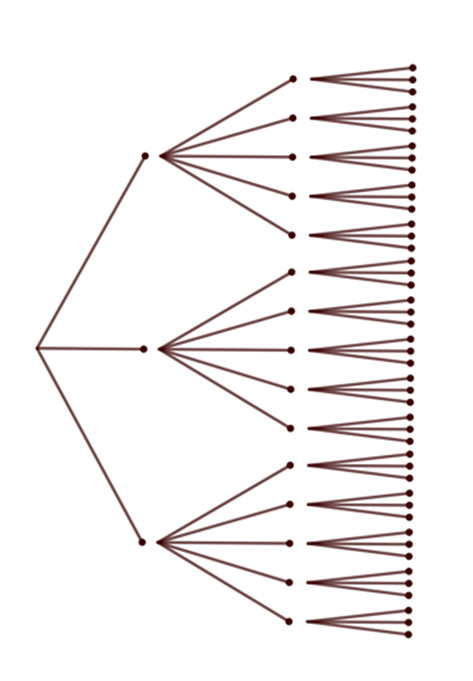
Tree diagrams of repeated or successive trials clearly reveal the multiplicative principle involved in counting their outcomes. Take Marcello the clown. He has three top hats of different colors, five jackets likewise of different colors, one pair of plain trousers, another striped pair, a pair of shorts, and a pair of shoes (far too big). How many stage outfits does that give him if he pays no attention to matching?
We draw a tree from left to right: one level for the top hat (three branches), one for the jackets (five branches from each existing endpoint), and one for the trousers and shorts. Clearly, the number of outfits is 3×5×3, or 45.
Repeated trials
-------------------------
When the same trial with two outcomes (heads or tails) is repeated, the possibilities can be represented by a tree in which each repetition adds two branches, one for each result: P for heads (upward) and F for tails (downward). With two trials, we can see that there are exactly 2 × 2 = 4 outcomes. With n trials, there are 2 *n*.
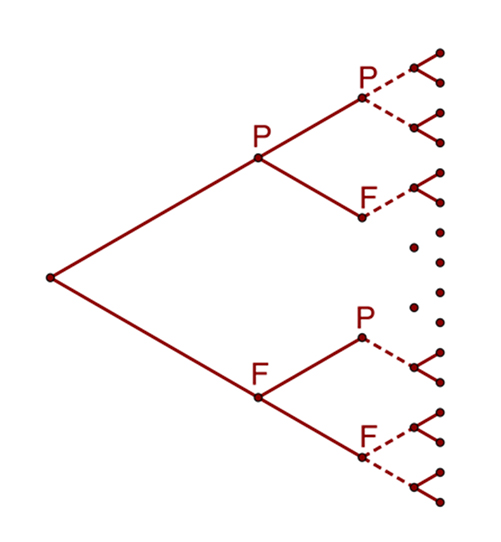
Among these outcomes, let us consider how many contain a fixed number of heads. With two trials, we may obtain either two Ps, just one P, or two Fs, with two possible ways of obtaining the intermediate case.
In n trials, the number of outcomes (paths through the tree) with k Ps is where k ranges from 0 to n; this is the number of paths with k upward branches. Since the total number of outcomes is 2 *n* and is also the sum of all the we necessarily have
By symmetry of the tree, .
References
• Feature: "Les paris" (Betting). Tangente 136, 2010.
• Feature: "Les mathématiques des paris" (The Mathematics of Betting). Tangente 175, 2017.
• Feature: "Le triangle de Pascal" (Pascal's Triangle). Tangente 176, 2017.