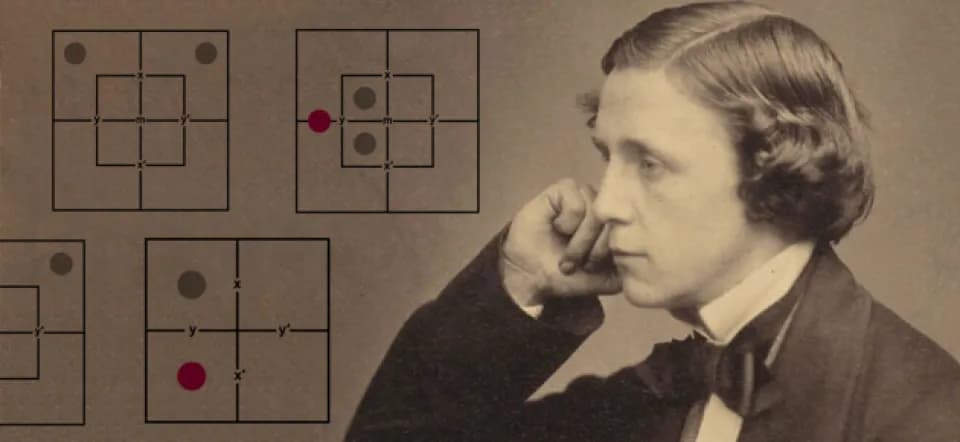
The British writer Lewis Carroll was not merely a successful author; he was also a mathematics lecturer. An amateur photographer, he was also an inventor. Among his creations was a "game of logic" (see Lewis Carroll, vers la logique moderne, in Les Ensembles, Bibliothèque Tangente 61, 2017). The game teaches us to play with syllogisms—arguments consisting of two premises and a conclusion—such as the following.
The setting is an association open to Italians and foreigners, adults and minors. At its general meeting, each member may be either present or absent, naturally giving rise to three pairs of categories: "Italian / foreigner," "adult / minor" and "present / absent." At one of the association's section meetings, the following situation arises:
Premise 1 (the major premise): No Italian is absent.
Premise 2 (the minor premise): All adults are absent.
Can we then draw the conclusion: "All adults are foreigners"?