The workshops
-------------
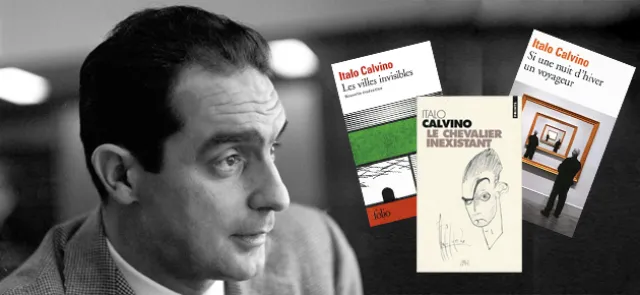
Raymond Queneau and François Le Lionnais, both writers and mathematicians, founded the Ouvroir de littérature potentielle (Oulipo) in 1960 to study every possible way of writing an innovative text within self-imposed constraints, including mathematical ones. Like its two founders, Oulipo members are co-opted from among scientists with a passion for literature and writers with an affinity for mathematics. Claude Berge (1926–2002), one of the founding members, was a specialist in mathematical graph theory and introduced the concept of a perfect graph in 1958.
François Le Lionnais later inspired the creation of OuXpos, with X standing for other forms of expression, from painting (X = "pein") to comics (X = "Ba") and detective fiction (X = "lipo").
François Le Lionnais, a pioneer
--------------------------------
The "Oulipians" delight in using graphs as a fundamental constraint, drawing inspiration from the way instructions for computers are presented. The text thus takes the form of a mathematical graph. At each branch, readers are invited to choose between the various paths open to them. The graph may branch regularly (in binary or ternary form…) or irregularly. François Le Lionnais broke new ground in 1967 with a proposal for a Nouvelle policière en arbre (see Un conte à votre façon, in Oulipo. La littérature potentielle (Créations Re-créations Récréations), Gallimard, 1973).
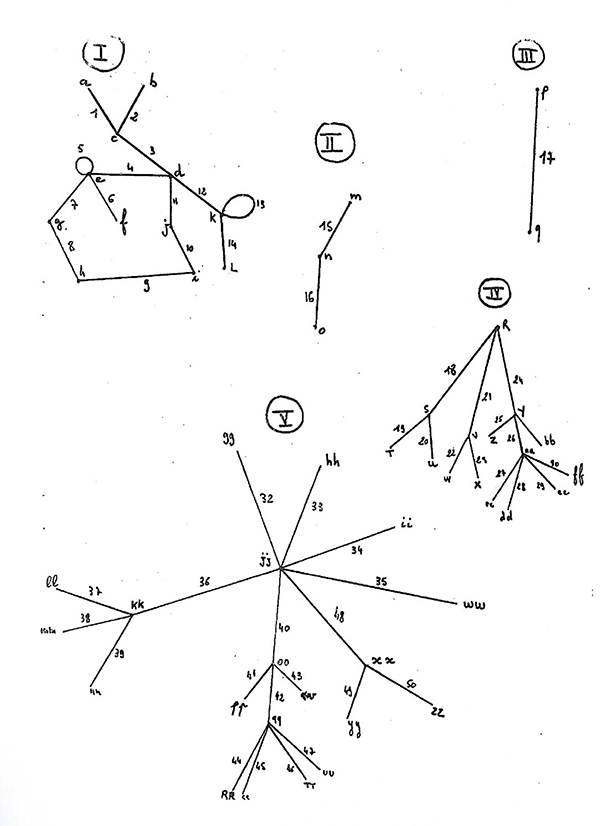
He then devised a Précis de dendrologie à l’usage des autoroutiers (Enigmatika 9, 1978); here are the tree structures it contains.
Thimothée and his tree
----------------------
Paul Fournel, a writer, poet and president of Oulipo from 2003 to 2020, was captivated by the constraint of writing in the form of a binary tree. His first theatrical experiment was L’Arbre à théâtre (see Les Graphes, Bibliothèque Tangente 54, 2015, and the feature "Maths et théâtre" in Tangente 205, 2022).
He then "grew" Timothée dans l’arbre (Le Seuil, 2003), which plunges a child into a kind of existential dilemma: at the end of each of seven chapters, he is given a choice between two paths.
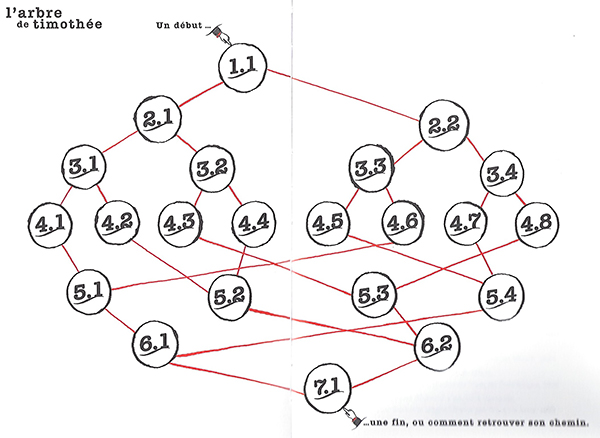
In Chapter 1, Timothée meets the character from Raymond Queneau’s Exercices de style (Gallimard, 1947) on a bus, and the character offers him a sweet. Readers are directed to Chapter 2.1 or 2.2 depending on whether they want Timothée to accept the sweet.
Chamboula
-----------
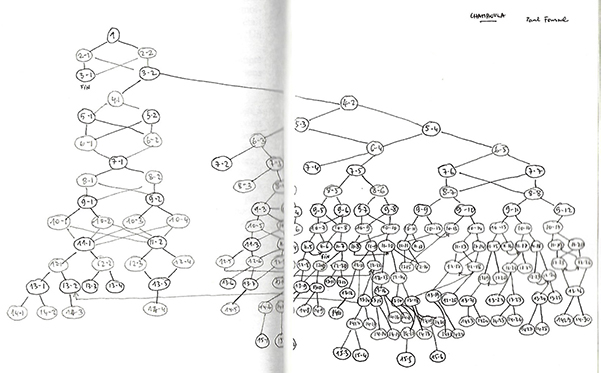
Paul Fournel followed with Chamboula (Le Seuil, 2007), the story of life in an African village disrupted first by the arrival of a refrigerator, then a television, and finally SAV, the white man who digs up the ground, dislodges the ancestors, abducts the beautiful Bamboula and wants to hire Boulot. What is to be done? Paul Fournel offers a multitude of paths and characters whose choices can shape the narrative:
Would you like the refrigerator or the television to be delivered?
Boulot wants to move abroad: will he be caught at French customs or settle illegally in Paris? Will he enrol at Sciences Po? Will he play on the right wing for ASSE?
The choices may also be technical:
Would you like a short paragraph of prose?
Would you prefer another page of dialogue?
Surprisingly, the book has no chapters and its paths are not marked by any questions: the formal rigidity of the binary tree succeeds in creating a powerful impression of general disorder, yet does not lose readers accustomed to accepting the multiple destinies of a single character and the contradictions between incompatible worlds. The author explains his approach in a welcome afterword on the making of Chamboula (and, more generally, on his art of writing and his vision of an ill-prepared modernism).