



The geometry of origami
Paper folding is not only a pleasant diversion that teaches patience, precision and rigor. It is also a wonderful opportunity to question geometry. The mathematical results found by studying origami are indeed numerous, deep and full of surprises. One can thus exactly construct numbers that are inaccessible to the ruler and compass of Euclidean geometry. Or obtain any polygonal shape using… a single cut of scissors. Or identify the fold maps from a 'real' folding thanks to a few elementary but only recently discovered invariants. Paper folding, a mathematical discipline? You wouldn't believe it!
All articles in this folder
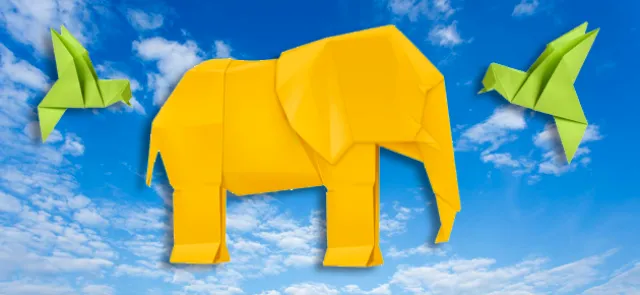
The Haga fold
Straightedge-and-compass geometry boasts a long history. But Euclid and his followers do not have a monopoly on points, lines and figures! The study of origami geometry is more recent, and it is surprisingly effective. Kazuo Haga has shown just how much richness a simple fold can hold.

History and theory of origami and paper folding | Tangente
Historically, the art of paper folding is thought to have emerged in China as early as the 2nd century BCE. Wherever it developed, the practice seems to have been closely linked to the advent of paper.

Folded paper and origami: many uses | Tangente
Paper is a material of choice for many artists. The art of folding takes several forms.
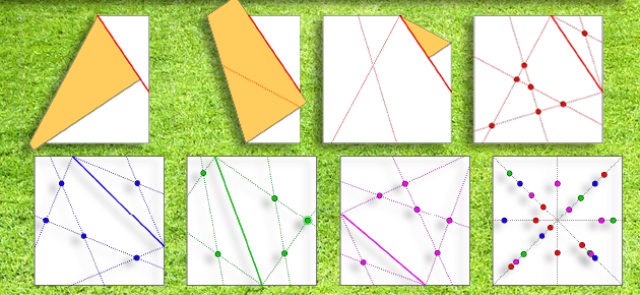
A wealth of constructions
Some constructions impossible to achieve with straightedge and compass become possible using origami… but not all of them! Paper folding also lets us revisit several questions of concurrency or collinearity, and reflect on the construction of polygons.

David Huffman, curved-fold origami pioneer | Tangente
Some artists' origami sculptures are often impressive, whether for their striking representational qualities, their painstaking detail, or their particularly pleasing geometry.
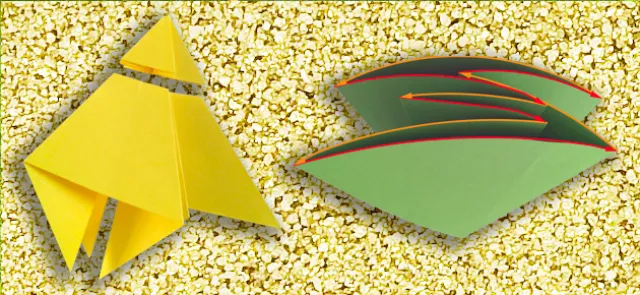
Origami crease patterns: the geometry of folding | Tangente
Studying the geometric figures obtained by fully unfolding an origami creation has led to general theorems that can be stated simply. These results quickly lead to questions connected to major open problems in mathematics.

The Demaines: a father-son duo passionate about folding | Tangente
Born in 1942, Martin Demaine initially studied glassblowing in Britain.

Origami in robotics and medicine | Tangente
No, this is no longer science fiction: origami-inspired minirobots can now deliver medication exactly where it is needed in the human body.