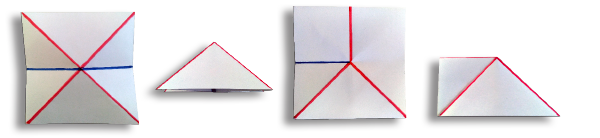
Take a sheet of paper and make your favorite fold — a crane, a plane, or a parasaurolophus. The key here is to produce a flat fold, that is, a piece you could slip between the pages of a book without damaging it. Unfold this creation and you get a sheet marked with mountain folds, valley folds, and a few folds that, in the end, are not needed for the final object. The result can then be summed up in a diagram showing the mountain folds as red segments and the valley folds as blue segments. This is what is called the fold pattern, or the crease pattern (the term crease pattern is standard in the origami-math literature).
Theorems within fold patterns
-------------------------------
Fold patterns hold a few treasures. We can start by looking at some very simple cases. It is quite difficult to picture the final result from a fold pattern. Even so, these patterns are enough for the most seasoned origami practitioners to share their creations with one another.
####