Origami notation
----------------
It appeared in Japan from the 7th century onward: origami was used there for its symbolic significance, in ceremonies, as a good-luck charm or in gift-giving. Examples of paper-folding practices have also been reported in Germany, Spain and Italy, though without the same significance. The history of this art is difficult to trace because knowledge was passed down orally, through demonstration.
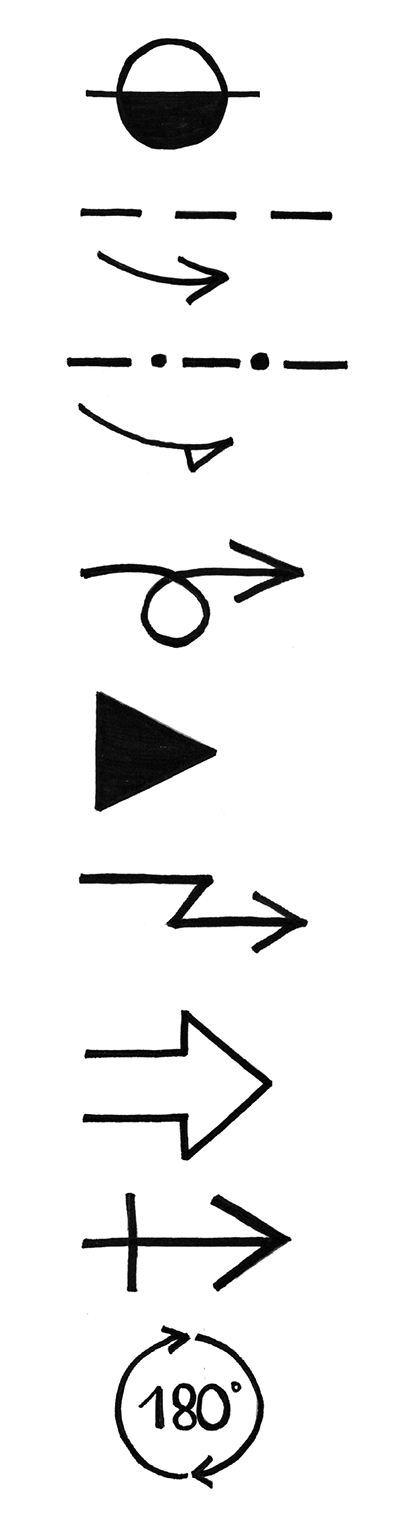
Origami enjoyed a real revival when instructional books began to appear, thanks in particular to masters such as Akira Yoshizawa (1911–2005). Since then, an origami notation system has been developed to codify every stage of folding. Different dotted lines indicate mountain and valley folds, while a set of roughly ten arrows denotes actions such as folding and unfolding, folding the front or rear layer, opening the model, turning it over, repeating an operation and rotating it through a given angle… Learning this notation, together with a few basic forms, makes it possible to tackle increasingly elaborate models with confidence.
Jacques Justin: the art and theory of paper folding
---------------------------------------------------
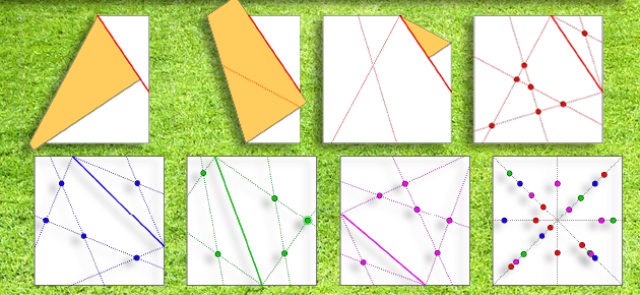
The French Paperfolders' Movement (MFPP) owes much to one of its founding members, the mathematician Jacques Justin (1926–2020). He helped formulate the seven axioms of origami, known as the Justin–Huzita–Hatori axioms (see below). Humaki Huzita (1924–2005) was an Italian-Japanese mathematician and artist, while Koshiro Hatori (born in 1961) is a Japanese author of books on origami. Together, the three codified all possible folds on a sheet of paper in terms of its lines and points. The first six axioms were discovered by Justin in 1989 and then rediscovered by Huzita in 1991; the seventh was stated by Hatori in 2002.
Justin's countless articles in the MFPP's journal Le Pli, in PLOT, published by the Orléans-Tours regional branch of the APMEP, and in L'Ouvert, published by the IREM of Strasbourg, remain authoritative references today.
The seven axioms of origami
----------------------------
• Given two distinct points *p 1 and *p 2, there is exactly one fold passing through *p 1 and *p 2.
• Given two distinct points *p 1 and *p 2, there is exactly one fold that brings *p 1 onto *p 2.
• Given two distinct lines *d 1 and *d 2, there is exactly one fold that brings *d 1 onto
*d 2.
• Given a point p and a line d, there is a unique fold perpendicular to d that passes through p.
• Given two distinct points *p 1 and *p 2 and a line d, there is exactly one fold that places *p 1 on d and passes through *p 2.
• Given two distinct points *p 1 and *p 2 and two distinct lines *d 1, *d 2, there is exactly one fold (the Beloch fold) that places *p 1 on *d 1 and *p 2 on *d 2.
• Finally, given a point p and two distinct lines *d 1 and *d 2, there is a unique fold that places p on *d 1 and is perpendicular to *d 2.
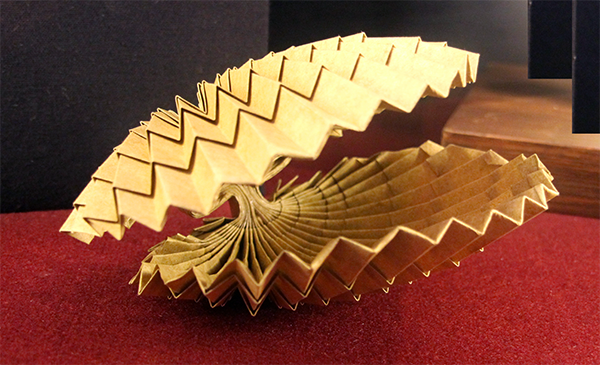
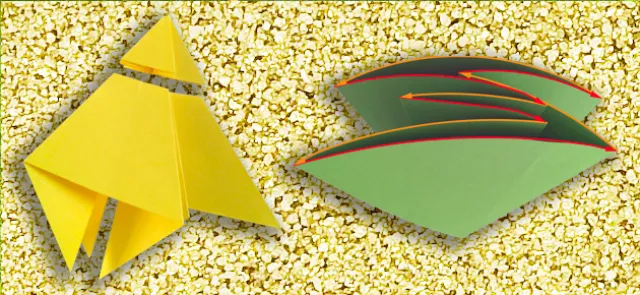
Scallop shell, by Éric Joisel.
A new geometry
--------------
Origami geometry is a very recent discipline. Like other geometries, it rests on a number of axioms (seven here; see opposite), from which propositions and theorems can be deduced. The article Origami et Pliages pour construire (in Bibliothèque Tangente 78, 2022) examines all seven in detail and presents some of the results they make possible. In particular, the axioms can be used to construct lengths that cannot be obtained with straightedge and compass. Origami geometry can therefore solve the problems of doubling the cube and trisecting the angle (see the article "Des constructions à foison").