His work in this field soon gained recognition in the United States and Canada, where several major museums added some of his pieces to their collections. He homeschooled his son Erik Duncan, born in 1981. Equally renowned as a mathematician and an artist, Erik earned his doctorate at the age of 20 with a thesis entitled Folding and Unfolding; that same year, he became the youngest professor ever appointed at the Massachusetts Institute of Technology (Cambridge, United States). His father is an artist in residence there.
Erik's mathematical research focuses primarily on origami, but also encompasses computational geometry, graph theory, algorithms and data structures.
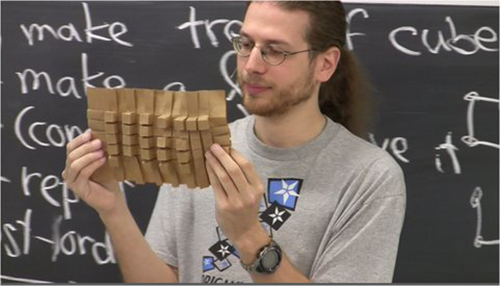
Together with Anna Lubiw (born in 1957), who supervised Erik's thesis, the Demaines proved the "fold-and-cut theorem" (fold-and-cut theorem) in 1999. It states that any straight-sided geometric shape can be produced from a single sheet of paper by folding it flat and making a single straight cut. The shape may be a concave or convex polygon, with or without holes, and may consist of several separate pieces.
Martin and Erik Demaine have created works combining origami and mathematics that are on display at the Museum of Modern Art; their work and publications can be found on the fascinating website erikdemaine.org.