The paper crane, a symbol of peace
-------------------------------------
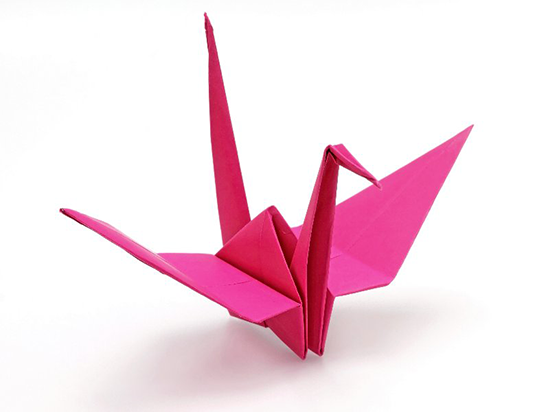
The Japanese city of Hiroshima entered human history on August 6, 1945. Sadako Sasaki was two years old at the time and miraculously survived the devastating bombing, although everyone around her was seriously injured or killed. She grew up with a passion for running. In 1954, she developed leukemia linked to the events of 1945. According to a Japanese legend, anyone who makes a thousand paper cranes will be granted a wish. The little girl took up the challenge with enthusiasm, hoping to recover and run again.
When she had folded five hundred cranes, she seemed to be getting better. Sadly, she relapsed soon afterward and, despite help from her classmates, died in October 1955, having made more than six hundred paper cranes. Her friends continued her touching endeavor and folded the remaining cranes.
The paper bird has since become a symbol of freedom, and every year children fold thousands of cranes, which are placed at the foot of a statue of Sadako in Hiroshima's Peace Park.
Teaching through folding
--------------------
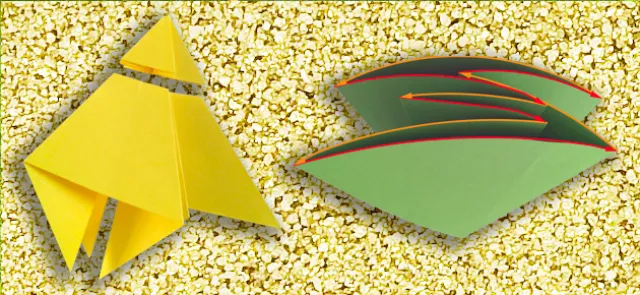
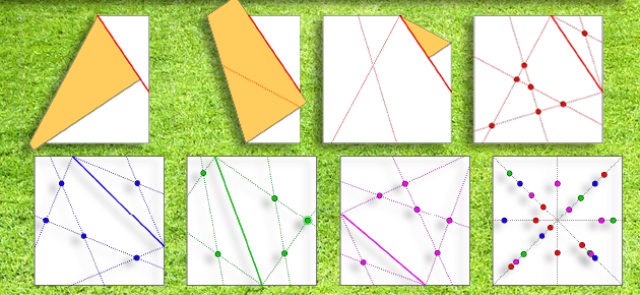
Issue 57 of Tangente Éducation, devoted to "Folding and origami," offers several ideas for using paper folding in the classroom. This widely underused practice has many benefits, both for acquiring transferable skills and for learning mathematics. Readers will find ideas for teaching materials at every level, from primary school to university: studying crease patterns in primary school, counting and fractals via modular origami, illustrating middle-school theorems through folding, spatial geometry and conic sections in high school, the fixed-point theorem, and algorithms for constructing lengths exactly and approximately…
This special feature can be supplemented by the many resources available on origami—or paper folding more generally—and mathematics, including "La mathématique du pliage" in Tangente 146 (2012).
####
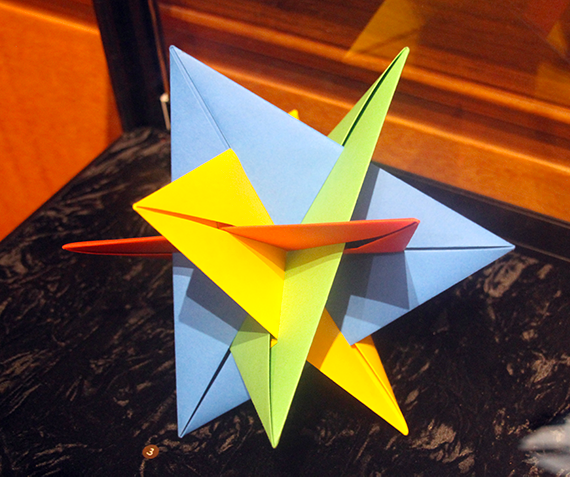
WXYZ. Valérie Barrière, modular origami after Sébastien Limet.
Paper, a material for artists
----------------------------------------
From the Japanese oru, "to fold," and kami, "paper," origami is the art of folding paper. In its purest form, it consists of making a sequence of folds from a single square sheet. These rules can of course be bent to broaden the possibilities. One can begin with a rectangular sheet or, why not, a sheet of any other polygonal shape.
The choice of paper offers scope for playing with colors and textures; for example, a sheet of tissue paper can be glued to each side of a sheet of aluminum foil. Some artists crumple or dampen the paper to shape it, create curves, and achieve particularly realistic effects.
Kusudama (from kusu, "medicine," and dama, "ball") is a form of origami that uses several sheets of paper—sometimes hundreds—to create spherical forms originally intended to hold incense or potpourri. Today, their aesthetic appeal is the main consideration. The different elements may be glued or sewn together. When these elements are identical and the modules are assembled solely by folding and interlocking, this is known as modular origami. The resulting sculptures, more often geometric than figurative, are sometimes spectacular.
In Japanese culture, chiyogami (literally, "thousand-year paper") encompasses all the arts involving paper. In addition to origami, these include kirigami (from kiru, "to cut"), in which paper is cut with great precision, and the more recent pepakura (from "papercraft"), which uses cutting and gluing to create static or moving three-dimensional objects and models.