In Algorithme (Grasset, 1948), Alexandre Arnoux tells the story of our hero through Damase Lagnet, a fictional former schoolmate who, forty years after Galois's death, recalls the defining events in the life of the mathematician, nicknamed Algorithme.
Le roman d’Évariste (translated from Whom The Gods Love, the Story of Évariste Galois, Whittlesey House, 1948) by Léopold Infeld (La Farandole, 1957) begins in January 1824 with a rebellion by students at the collège Louis-Le-Grand and ends on June 13, 1909, at the unveiling of a commemorative plaque in Bourg-la-Reine, with these words from the mathematician Jules Tannery: "Let me thank you for giving me the opportunity to make amends to Galois's genius, on behalf of a school that he entered reluctantly, where he was misunderstood, from which he was expelled, and of which he is one of the greatest glories."
After his first book, Évariste (1811–1832), le roman d’une vie (Aléas, 2004), Jean-Paul Auffray wrote another novel with a striking title, Icare trahi (Vivianne Hamy, 2011), a maze of historical setbacks, mathematical conjectures, and mysteries.
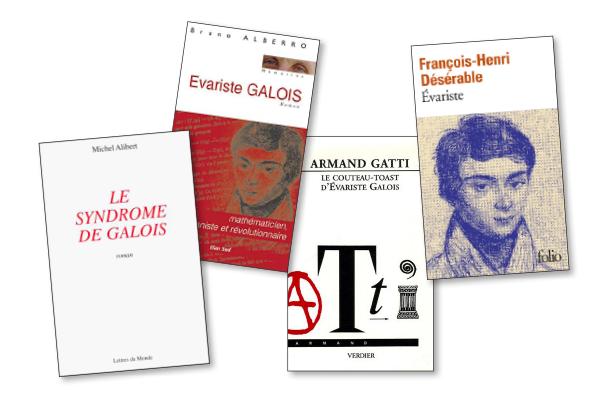
In Évariste (Gallimard, 2015), François-Henri Désérable takes a few liberties with events in the mathematician's life, creating a delightful flight of fancy that addresses an imaginary reader with plenty of irony and deadpan humor. By contrast, Jacques Cassabois offers a reconstruction that remains as close as possible to the historical record and biographical facts in Je n’ai pas le temps, le roman tumultueux d’Évariste Galois (Hachette, 2019). The text incorporates numerous archival writings, distinguished by italics.
Other works include Bruno Alberro's Évariste Galois, roman (Élan Sud, 2007), Michel Alibert's Le Syndrome de Galois (Lettres du monde, 2000), and Armand Gatti's Le couteau-toast d’Evariste Galois (Verdier, 2006). André Lutaud's play Évariste Galois. L’intransigeant (Pensée universelle, 1991), meanwhile, brings Galois and Nerval together in conversation at Sainte-Pélagie Prison.