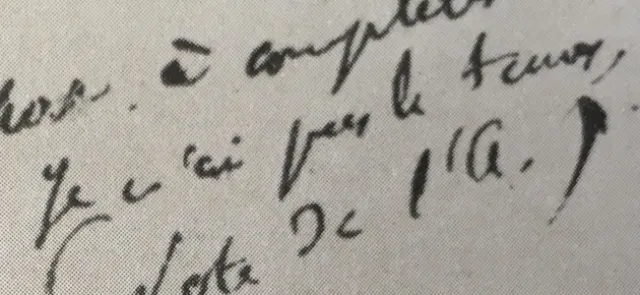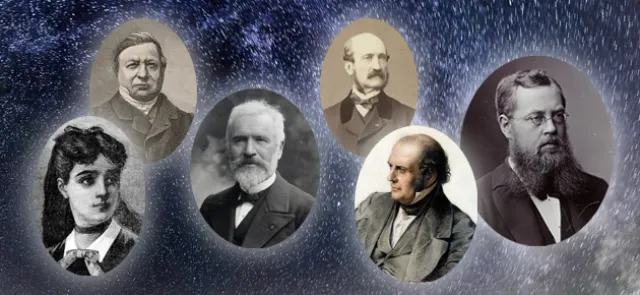
His mathematical work transformed the study of algebraic equations. Very few of his papers appeared during his lifetime (almost all were written in 1830, two years before his death at the age of 20). His first two memoirs were lost, and much of what he wrote survives only as incomplete drafts reconstructed after his death. In one of these drafts, certain proofs give way to the famous words "I don't have time".
Furthermore, what we now call "Galois theory" is the culmination of a vast mathematical undertaking spanning several decades. Research began sixteen years after the young adventurer in science met his untimely death, drawing on a handful of particularly innovative ideas found among his papers—ideas that can be said to have contributed to spectacular advances in mathematics. Yet this fundamental field, which is quite difficult to explain to a general audience, remains the preserve of specialists.
Unlike his mathematical work, his life is rich enough in mysteries and novelistic twists to invite all comers to make his story their own, giving rise to hypotheses and legends. Galois was a rebel at odds with the establishment. Denied admission to the École polytechnique, expelled from the École normale, misunderstood by the Académie des sciences, imprisoned, challenged to a duel… His short life was a cascade of events that earned him a reputation as a doomed mathematician. Shrouded in mystery, it remains an enigma that many are still trying to unravel, further fuelling the "Galois legend."
What do we really know about Évariste Galois? With this issue, we hope to provide a few pointers to help readers find their way through the multitude of accounts about him.