It was not until the second half of the 19th century that this was achieved, first through Hermann Grassmann’s work as early as 1861, then more formally by Richard Dedekind in 1888 and by Giuseppe Peano, who made the principle of induction an axiom in his definition of the integers the following year. The word itself entered mathematical vocabulary around the turn of the 20th century.
Recurrens is the present participle of the Latin verb recurrerre, meaning "to go back"; it could refer, for example, to returning to the same place, as a celestial body does after one revolution. The term contains the prefix re, which already denoted repetition at the time, placed before a verb meaning "to run."
It appears in the famous line by the Latin poet Horace, "Naturam expellas furca tamen usque recurret" ("You may drive nature out with a pitchfork, but it will always come galloping back").
"Recursive," a relatively recent addition to mathematical vocabulary, is formed from recursum, the supine (a kind of past participle) of the same Latin verb. In logic and computer science, it describes a procedure that calls itself; the Latin sense of "going back" is clearly present here.

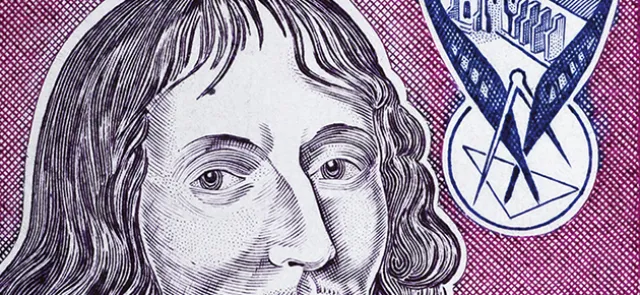
Suite Segond (60F). Bernard Frize, 1981.
Iteration and processes
----------------------
The term iteration is used in many situations where an experiment is repeated. The Latin word iteratio already had the same meaning. Introduced into French in a Frenchified form during the Renaissance, it was soon displaced by "repetition." It returned, borrowed from English in its mathematical sense, shortly after the First World War.
When a random experiment is repeated indefinitely, we call it a random or stochastic process. The word "processus" shares its etymological root with the French words "procès" and "procession"; it is in fact a Latin term meaning "progress" or "progression." It appeared in French in the 16th century, competing with its French counterpart "procès" and confining that word to the legal sphere. Its use spread to psychology at the very beginning of the 20th century and then to various scientific disciplines. The study of the convergence of sequences of random variables, driven in particular by Andrei Markov and later Paul Levy, developed in the early 20th century; it was then that the expression "random process" (or "stochastic process") entered mathematical vocabulary.
References
Le Robert, a historical and etymological dictionary of French, edited by Alain Rey.
*Les mots et les maths.* Bertrand Hauchecorne, Ellipses, 2003 (2014 for the "paperback" edition).
Recurrence or induction?
-------------------------
In Latin, inductio denotes "the act of leading" and, by extension, means "resolution." Cicero used it to translate the Greek epagôgê, which Aristotle employed in logic to mean "the act of leading through reasoning." In scientific French today, it refers to a mode of reasoning that starts from individual observations and is used to infer a general law; this is especially common in physics. The opposite of this approach is deduction, which seems more familiar in mathematics. In mathematics, however, induction is used to posit a result, which is established only later through deductive reasoning.
Most Western languages use the word "induction" for what French calls mathematical induction. German even uses the term complete induction (vollständige Induktion). The idea, of course, is to prove a statement for every integer: establish it for 0 (or another starting integer), then show that it passes from n to n+1.
We leave it to readers to decide whether mathematical induction is a form of deduction or of induction. This type of proof seems intuitively natural to us, but Peano needed it to define the integers axiomatically.