The American Samuel Loyd (1841–1911) was one of the most prolific puzzle makers of the late 19th and early 20th centuries. He invented—and, above all, popularized—a great many logic and mathematical puzzles. The best known is a permutation puzzle, the 15 puzzle, a two-dimensional precursor to the Rubik's Cube, which enjoyed success from the 1870s onward—Sam Loyd's 15 puzzle—on a scale comparable to that of the cube a century later.
**
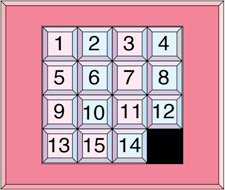
** Sam Loyd's 15 puzzle
**

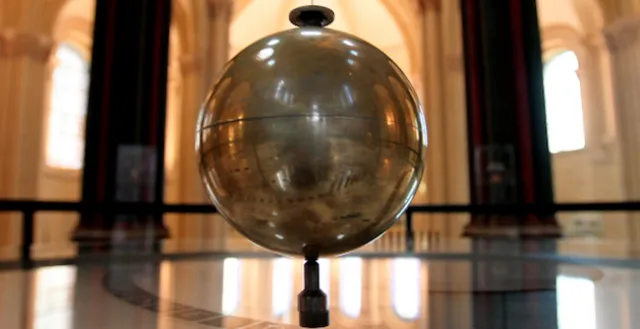
* One fine late-summer day in 1666, Isaac looked up at the sky and saw the Moon, round and white, above him. Suddenly, an apple came loose and fell nearby! "If the apple fell, the Earth must exert some attraction on it. But then why does the Moon not fall too?" Newton wondered. After some thought, he understood: "The Moon is falling too!" He explained this in his Principes Mathématiques de la Philosophie Naturelle, as we read in Book Three, Proposition IV, of the work translated by Émilie du Châtelet. His illuminating explanation, from which he derived the law of universal gravitation, is very simple to set out: The Moon gravitates toward the Earth and is continually drawn away from straight-line motion by gravity and held in its orbit. The force that holds the Moon in its orbit is directed toward the Earth and varies inversely as the square of the distance between the Moon and the center of the Earth.*
Although everyone knows of Lewis Carroll's gifts as a writer and storyteller, it is sometimes forgotten that he was fascinated by logic, which he used to fuel his immense creativity and love of games. The connection he forged between mathematical logic and wordplay made him one of the forerunners of the Oulipian movement founded by Queneau in 1960. Lewis Carroll contributed to many newspapers, publishing mathematical puzzles as well as word games: doublets, word ladders, charades, acrostics… His creativity also found expression in many other fields. Among his inventions were a telegraph code, a method of shaving without soap, a seating plan designed to prevent guests from jostling one another (later used by the Queen of England), adhesive for envelopes in place of a wax seal, a new way of folding maps, and even an electoral system derived from Condorcet's analysis!
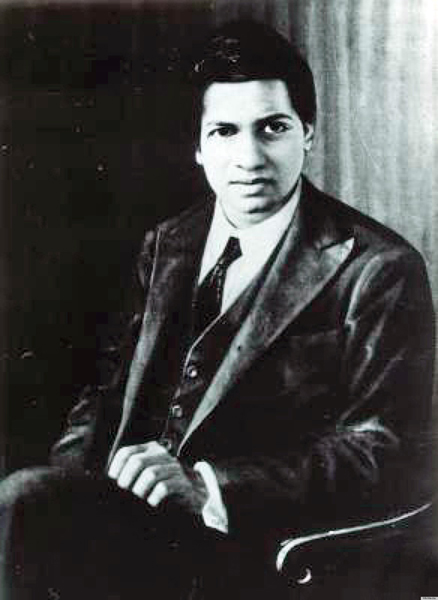
Srinivasa Ramanujan died at 32, Schubert at 31, Abel at 27, Mozart at 35 and Galois at 20. Yet no one would say that any of the latter four had a brief life: each gave full measure of his genius. With Ramanujan, the situation is different and rather strange. Ramanujan had an immediate grasp—not a universal grasp, in the sense of universals—of certain mathematical objects, but could not articulate it in the language shared by mathematicians. This was fundamentally linked to his years of study. Ramanujan's body of work is unfinished, not only as a whole but in each of its parts. This gives it a prophetic quality that has fascinated readers ever since: long after his death, Ramanujan remains a natural genius and a mathematician in the making.