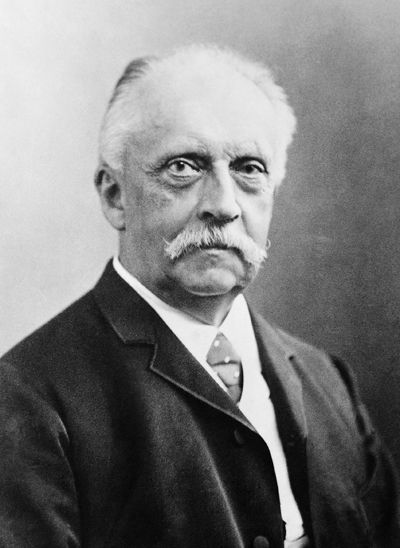
After training as a physician, Hermann Ludwig Ferdinand von Helmholtz (1821–1894) turned to mathematics and physics. This enabled him to study sound phenomena from the perspectives of physics and mathematical modeling, but also as phenomena perceived by a living organism. His book Théorie physiologique de la musique (Masson, 1868) made a deep impression on his contemporaries. Helmholtz was chiefly interested in musical sounds and focused on three parameters essential to music: intensity, pitch and timbre.
-
Characteristics of sound
---------------------
For a given sound, its pitch is the quality that makes it low or high and corresponds to a frequency at which the air vibrates. The physicist Joseph Sauveur (1653–1716) is regarded as the founder of scientific acoustics. He systematized experiments showing that, when exposed to a sound, the free strings of an instrument whose natural frequency matched that of the sound began to vibrate spontaneously. The same was true, however, of strings (shown in red in the diagram) whose natural frequencies were twice, three times or some other integer multiple of that frequency.