Rethinking workplace training
------------------------------------
Personalization is now an integral part of our lives—tailored news feeds, video recommendations, targeted advertising…—and training is no exception. In practice, we can now learn through educational content tailored to our level, preferences, pace and goals.
Digital technologies are collecting and storing ever more data about how we learn. Processed using techniques including machine learning algorithms, these data help us better understand each learner, making it possible to recommend learning paths, courses and content suited to them—and thus help them build their skills. This technology is known as adaptive learning.
Domoscio develops adaptive learning technology for integration into training systems. Alongside personalized learning paths, data are collected to measure the impact of learning and plan review programs. Companies can therefore improve how their employees acquire and manage skills.
-
Inside learners' minds
---------------------------
Artificial intelligence technologies have opened up many avenues in educational research. One application is the analysis of digital traces of students' activity on MOOC-style platforms, which log a large number of connections. This makes it possible to provide feedback to teachers, platform users and designers.
Models are used to represent students and their knowledge. They are mainly graphs that are updated in real time as students answer questions. The aim is to identify the source of a student's difficulties. Is it because the student does not know "the" formula, has not recognized when it applies, or simply has not mastered the underlying calculations? Here too, analyzing large volumes of data and using techniques that automatically fine-tune diagnostic systems can yield increasingly accurate assessments. These topics are explored in issue 46 of Tangente Éducation.
-
Intelligent assistants
---------------------------
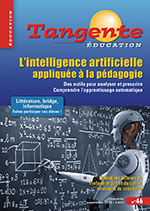
Artificial intelligence applied to teaching is the theme of issue 46 of Tangente Éducation, a magazine for mathematics teachers and anyone interested in the challenges of "mathematics education." In this field, advances in AI technology are having an impact in many ways. Without replacing teachers, these technologies considerably extend what they can do, providing tools that analyze their students' performance in real time and resources for individualizing learning paths. Repetitive work—students practising and teachers marking—can be automated, freeing time for more advanced cognitive tasks. For students, this means tailoring the level and frequency of exercises to their actual needs. For teachers, time saved on marking and tools for analyzing both individual and collective responses help them tailor their teaching to their class's difficulties, making their lessons more relevant. We are therefore moving towards "intelligent assistants" whose next generation will be able to explain their choices.