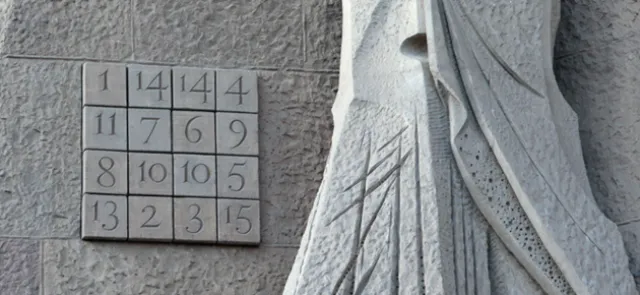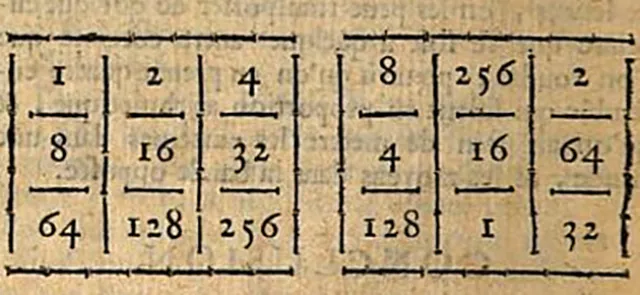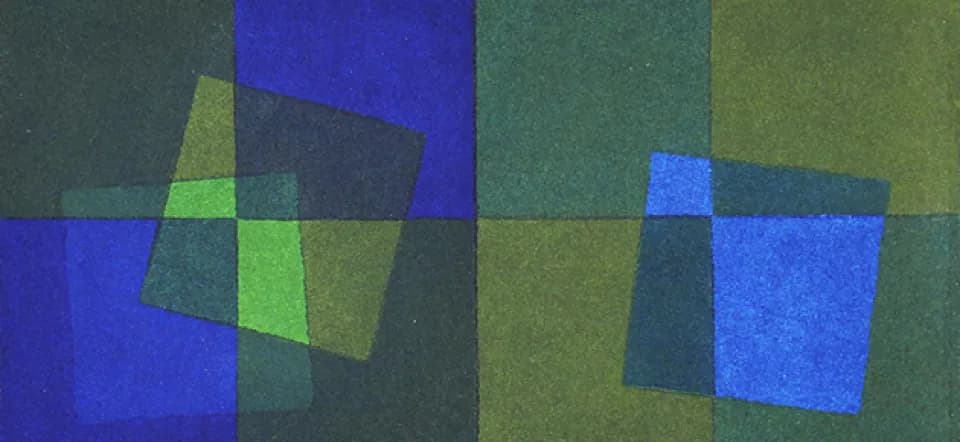
A century ago, Albert Ayme (1920–2012) was born near Montpellier, in the Hérault region. He is a perfect example of an artist who found in mathematical objects an indispensable tool for developing his approach and articulating his vision of the creative act. From the outset of his career, he showed little interest in figurative art. He soon felt the need to move away from all subjectivity and adopt a structured language; mathematics would aid him in his explorations. To understand how Albert Ayme came to work with magic squares, let's look at how his PARADIGME project began.

The nine basic configurations in the artist's system.
A counting problem
----------------------------
From 1964 to 1974, Ayme worked on developing a system he called PARADIGME, based on pictorial signifiers that he paired in oppositions such as ground/form, addition/subtraction, opacity/transparency, flat area/cutout, black/gray, white/gray…