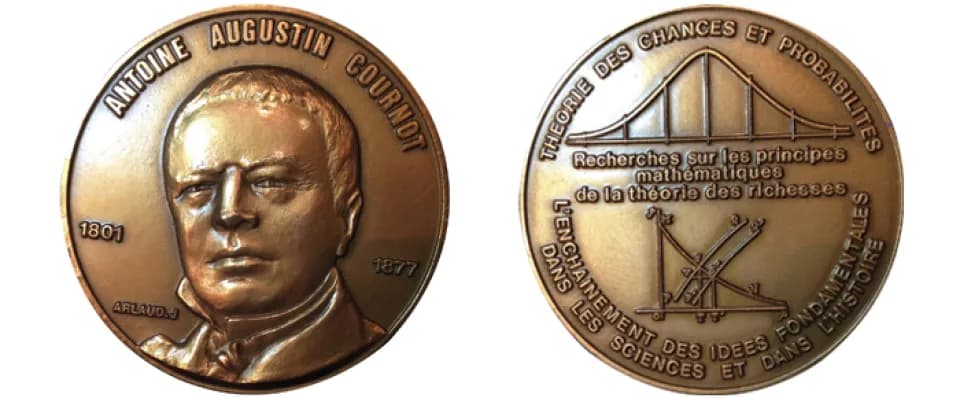
Until the final quarter of the 19th century, political economy held sway. But mathematical economics gained a lasting foothold, bringing to "economic science" the power of reasoning it had lacked. The history of this transformation was shaped by the ideas and research of various European and American scholars. Among them was the French mathematician Antoine-Augustin Cournot, who introduced many new concepts that have been taken up and widely used ever since.
-
Political arithmetic
------------------------
In economics, there is a "before" and an "after" Cournot. The "before" goes back a long way: one of the earliest treatises to address the subject was written by Xenophon (430–355 BC), an ancient Greek philosopher and soldier who studied under Socrates. His work Ο?κονομικ?ς, "L'Économique" (The Estate Manager), introduced the word, formed from ο?κος, "house", and ν?μος, "law". In the form of a Socratic dialogue, it discusses "the art and practice of managing a large agricultural estate well". The arguments exchanged by Socrates and Critobulus, a wealthy landowner, are largely philosophical, with Socrates proving to his interlocutor that he is "poor in his wealth, while Socrates himself is rich in his poverty". Only one idea is worth retaining—it appears in the final chapter: "In agriculture as in politics, economics and the command of armies, the fundamentally useful asset is a talent for leadership." There was very little economic theory, then, and no mathematical reasoning at all, since Xenophon, like Socrates, believed that only useful mathematics was worth knowing. Mathematics was thus relegated to the role of a tool.
Later, during the Renaissance and then from the 17th century onward, economics freed itself first from morality and then from politics to become an autonomous social science. Few authors, however, brought mathematics into their treatment of the subject. The British polymath William Petty (1623–1687) was already breaking new ground: he not only laid the foundations of statistical demography but also introduced scientific practice into national accounting and the principles of taxation and public expenditure, while using functions to link the production of wealth, the money supply and the velocity of circulation. "Political arithmetic", as he called it, was born. Following in his footsteps, the Frenchman Pierre Le Pesant de Boisguilbert (1646–1714) created a model explaining how money circulates through society, while the Irishman Richard Cantillon (1680–1734) linked price levels and interest rates to supply and demand—all of which already involved mathematical reasoning.