Wassily Leontief, the first economic matrices
----------------------------------------------------
**
**
Wassily Leontief (1906–1999).
Leontief was born in Saint Petersburg into a family that destined him for this career: his father was a professor of economics. He began studying philosophy and sociology before turning to economics. After a stint at the University of Berlin, he was hired as a researcher at the University of Kiel to study and model supply and demand statistics. After a stay in China, he landed at the National Bureau of Economic Research in New York in 1931, then moved to Harvard, devoting himself exclusively to economics.
As early as 1931, he devised a general equilibrium theory adapted to empirical observations, and grew increasingly interested in the use of the first computers. This is how he created input–output analysis, a superb real-world application of basic matrix algebra. "Input-output" tables had already been proposed by the Frenchman François Quesnay (1694–1774) in Tableau économique, published in 1759, made up of synthetic, graphical representations of how the economy works. The table format proposed by Leontief lets us visualize any change in one economic sector and anticipate its repercussions on the others. Having become an American citizen, he received the prize in 1973.
-
John Nash, a question of equilibrium…
------------------------------------
**

**
=============================
John Forbes Nash Jr (1928–2015).
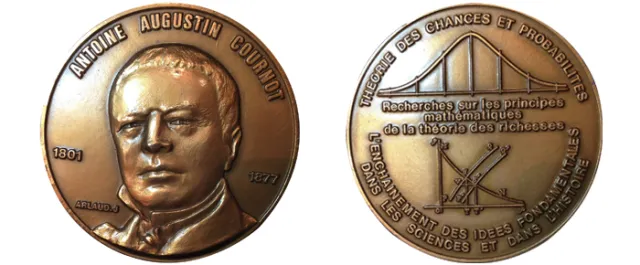
John Nash is that curious American mathematician and economist who suffered from schizophrenia and whose fictionalized life became the subject of the 2001 film A Beautiful Mind (directed by Ron Howard, with Russell Crowe in the title role)… which he hardly liked. His research covered a wide range of fields: he explored differential geometry, analysis, and partial differential equations. It was for his work in game theory that he was awarded the Sveriges Riksbank Prize in Economic Sciences in 1994, jointly with Reinhard Selten (1930–2016) and John Harsanyi (1920–2000). From the 1950s onward, Nash built on the work of John von Neumann and established the notion of Nash equilibrium, a kind of compromise among several players, corresponding to a form of optimal solution to a game such that no player can unilaterally change their strategy without weakening their own position. This concept attributed to Nash was already implicit in the work of Cournot. Thus, in a game of "rock-paper-scissors", the Nash equilibrium is reached if each player chooses one of the three options with a probability of one third.
-
Leonid Kantorovich, the development of linear programming
-----------------------------------------------------------------
**

**
Leonid Vitalievich Kantorovich (1912–1986).
Like his compatriot Leontief, Leonid Kantorovich was born in Saint Petersburg. A mathematician and economist, he became one of the specialists in optimization and was awarded the Nobel Prize in 1975, jointly with the Dutch economist Tjalling Charles Koopmans (1910–1985), for their work on the theory of optimal resource allocation. Kantorovich is best known as one of the inventors of linear programming and linear optimization in the 1930s. He applied his results to an attempt to optimize planned economic production, only to find himself confronted with the essential role of prices in the economy. He concluded that prices could also be determined by the scarcity of products, reintroducing the notion of marginal utility and running counter to Marxist theories asserting that the value of a good is determined exclusively by the quantity of labor incorporated into its production. It is therefore hardly surprising that Kantorovich's work was not published until after the Stalinist era, and that the economist twice narrowly escaped imprisonment. He is the only Soviet researcher to have received the Nobel Prize in economics.