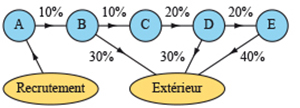
How can Markov chains—and hence mathematics—find their way into a company's workforce management? Let us consider an example: the career progression of managers in a large company whose workforce is assumed to remain constant at, say, 5,700 employees. The company has five hierarchical levels, labelled A, B, C, D and E. Each manager's annual progression is shown in the following diagram:
-
Representing corporate strategies
---------------------------------------
A constant workforce means that the number of people recruited each year equals the number who leave the company. Furthermore, according to the diagram, each year 10% of the employees at level A are promoted to level B, 10% of those at B are promoted to level C, while 30% leave the company, and so on. This is an example of a Markov chain: from an outside perspective, the percentages can be viewed as random, even though individual promotions are not.