Imagination rewarded
-------------------------
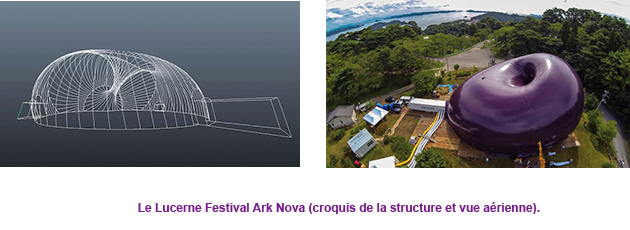
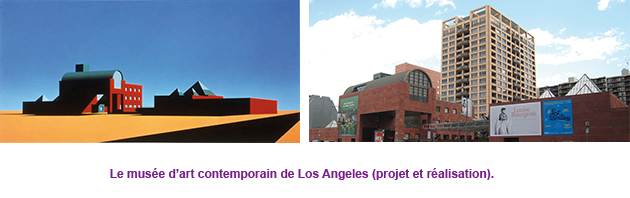
At 87, the architect—also a designer, urban planner and theorist—is being honored for a lifetime of imaginative work. Constantly finding new sources of inspiration and renewing his construction techniques, he has worked in every style, from raw concrete to futuristic forms. Yet his buildings have always had a simple geometric appearance, making striking use of triangular or cubic profiles and the interplay of light and shadow. What could be more understated than the almost toroidal form of the Lucerne Festival Ark Nova, an inflatable structure designed with Indian artist Anish Kapoor for a one-off concert honoring the victims of Fukushima? What could be more minimalist than the "rhetoric of the cylinder", as he himself put it, that guided the design of the Museum of Contemporary Art in Los Angeles?
For lovers of beautiful geometry
------------------------------------
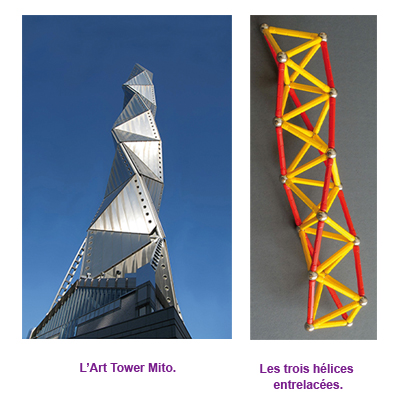
Arata Isokazi's architectural creations include buildings that sometimes draw on features only geometers can fully appreciate. One example is the structure of Art Tower Mito, an arts complex in the Japanese city of Mito, about thirty kilometers from Tokyo. The most spectacular part of the complex is its 100-meter tower, an assembly of twenty-eight tetrahedra known to specialists as the Boerdijk–Coxeter helix, which Buckminster Fuller also called the tetrahelix. The edges of the tetrahedra form three intertwined helices, with all their vertices lying on the surface of a cylinder; the structure does not repeat under either translation or rotation about the cylinder's axis.
Tradition and local culture
---------------------------
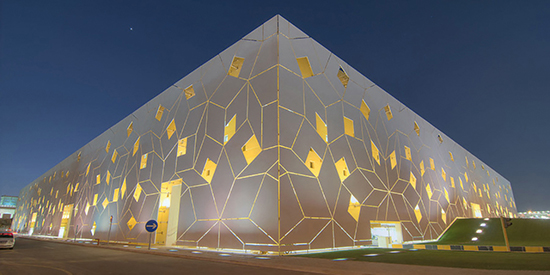
Attentive to local culture, Arata Isozaki drew inspiration from traditional Arabic mosaics for the decoration of the Liberal Arts and Sciences Building at Doha's Education City in Qatar. Leaving nothing to chance, he turned to geometry to lend the façade's tessellation mathematical precision.