C'est pas du toc : la chaînette sur un cône | Tangente
♦♦ C'est pas du toc


This article is not yet available in English; the French version is shown.


Articles recommended for you.

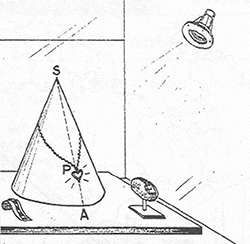
The parabola and the catenary are two grand dames of geometry, both with the same open U-shape. The first was studied by the Greeks 2,500 years ago; the second, "only" 330 years ago, by 17th-century mathematicians.

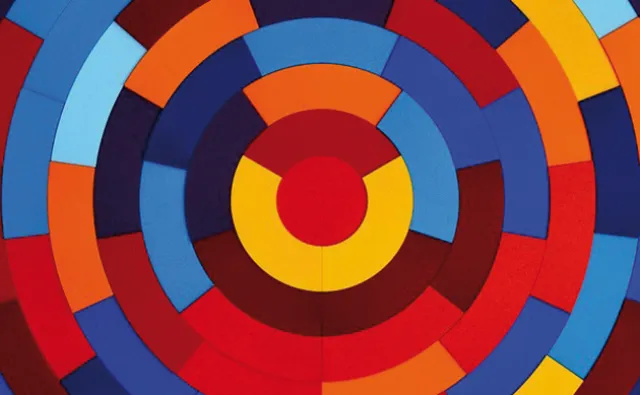
Visual artist Philippe Leblanc describes his artistic development this way: "Discovering Op Art, kinetic art and the abstract geometry of the 1960s and 1970s had a decisive influence on my artistic direction." Mathematical concepts and emblematic numbers are recurring features of his work.

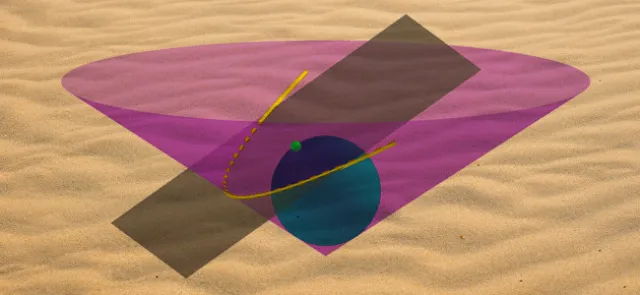
The parabola is one of the simplest curves to define, yet also one of the richest, with properties that make it a flagship object in classical geometry as much as in algebra and analysis. It thus offers an opportunity to bring together different mathematical perspectives.

Albrecht Dürer (1471–1528) devised a fascinating straightedge-and-compass construction of the ellipse. It foreshadowed descriptive geometry, which Gaspard Monge (1746–1818) would formalize almost three centuries later.