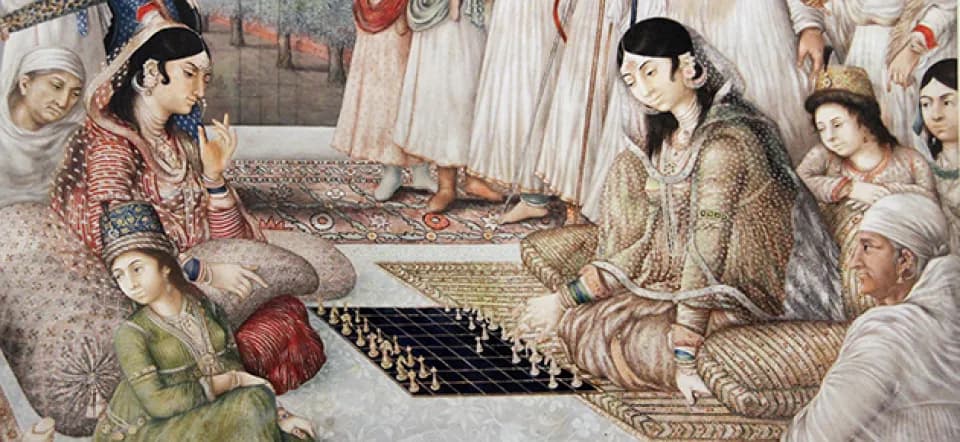
The story goes that Belkib, king of India, wished to thank Sissa, son of Dahir, the Brahmin who had presented him with the game of chess he had just invented. Sissa's wishes seemed very modest. "Your Majesty, he said, kneeling before the king, give me one grain of wheat for the first square of this chessboard, two grains for the second, four for the third and eight for the fourth. And so, O King, doubling the number from one square to the next, give me enough grain to cover all sixty-four squares of the board.
—You ask very little of me, O my faithful servant, exclaimed the king, privately delighted that his generosity toward the inventor of this miraculous game would make scarcely a dent in his treasury. Your wish shall be granted!" And he ordered that a sack of wheat be brought to Sissa.
Powering up
-----------
The operation began with one grain of wheat, then two, then four, and so on. As the nineteenth square was being "filled," the sack was emptied. A second sack was brought, but it too was emptied as the twentieth square was being filled. This caused some surprise, but the attendants soon realized that at least six sacks would be needed to fill squares 21 and 22.
The royal astronomer was summoned. He was a disciple of the astronomer and mathematician Arhyabata, who, like all Brahmins, was fascinated by large numbers and had invented not only "the" zero but also notation with which calculations could be carried out up to 1018. After laborious calculations, the royal astronomer announced that, to keep his promise to Sissa, the king would have to give him
18,446,744,073,709,551,615 grains—more than the kingdom's entire wheat production for the next twenty-seven thousand years! Whether the king took Sissa's request as an innocent joke or an insult is not known…